
Trim vs Trimless Recessed Downlights: A Basic Guide for Architectural Lighting
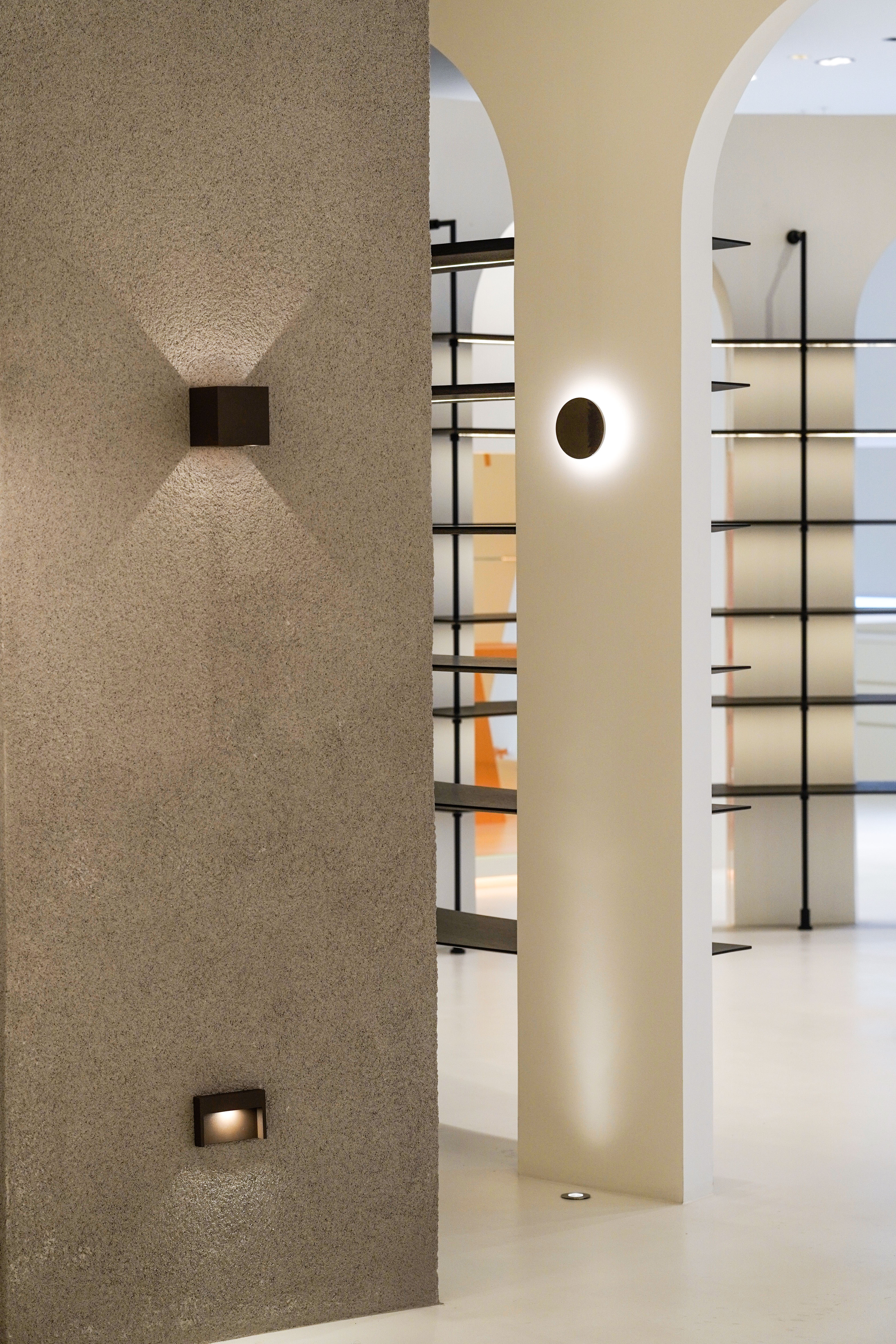
A trim downlight leaves a visible ring at the ceiling surface; a trimless downlight does not. That single line is the whole category distinction — but it is rarely the whole decision, because the visible ring also decides who finishes the ceiling edge, when the luminaire is installed, and how the fixture is reached for service later.
This guide is a terminology-first explainer for specifiers, lighting designers, contractors and buyers working with architectural lighting solutions. It defines both recessed downlight types, explains how each one meets the ceiling plane, sets out the installation and finish points that cause most site problems, and shows where dimmable downlights and recessed spotlights sit inside each option. Product references come from the current ALPHALUCE recessed range.
Why Trim Is a Ceiling Question, Not a Light-Engine Question
Trim and trimless describe the ceiling interface, not the optics. Two recessed downlights can share the same wattage, the same CRI ≥92 and the same colour temperature options and still demand completely different site sequencing, because one is finished by the lighting installer and the other is finished by the plasterer and painter.
Trim downlight: a recessed luminaire that keeps a visible flange or ring — a bezel — overlapping the ceiling surface around the cutout. The ring is part of the visible design and absorbs the joint between luminaire and plasterboard. In the ALPHALUCE recessed range, the ALDL1608 ceiling recessed dimmable spotlight and the ALDL1191 ceiling recessed bathroom spotlight are both stated as narrow trim designs.
Trimless downlight: a recessed luminaire whose aperture is finished flush with the surrounding ceiling, with no visible ring left on the surface. The ceiling itself becomes the visual edge. The ALDL1232 is a trimless ceiling recessed waterproof downlight with fixed mounting and a Ø60 mm cutout.
Because the difference sits at the plaster line, it belongs on the ceiling drawing and in the finishing specification — not only in the photometric report.
The Problem: The Same Word Means Different Things on Different Datasheets
In tender documents and supplier quotations, the term trimless is applied loosely. Three patterns cause most of the confusion:
- A very narrow trim is presented as trimless. A narrow bezel is still a bezel. The ALPHALUCE models described above as narrow trim keep a visible ring; the ALDL1232 is described separately as trimless with fixed mounting.
- Trimless is described as a property of a lamp rather than a system. Some trimless installations use a separate plaster-in frame; others are delivered as a complete fixture. The two have different fixing and access consequences.
- Only the cutout is quoted. Cutout dimension (the hole) and finished visible aperture (what remains after plastering and painting) are not the same number, and only the second one is what the client sees.
Industry Background: Why Ceiling Detail Became a Procurement Decision
Architectural lighting is a large and still expanding category. Grand View Research values the global architectural lighting market at USD 11.1 billion in 2025, with a projection of USD 17.5 billion by 2033. The same source attributes 50.9% of 2025 market share to the commercial segment and a 43.2% revenue share to Asia Pacific, with China as the largest country market. Fortune Business Insights separately valued the human-centric lighting market at USD 3.53 billion in 2024, reflecting the shift toward wellness-oriented design.
Those numbers matter to a trim decision in one specific way: the commercial end of the market is where ceilings run as long, uninterrupted planes and fixtures repeat in a grid. A bezel that reads as discreet in a single residential room becomes a visible pattern when it repeats across an open office or a hotel corridor. At the same time, office and retail lighting projects are routinely specified with high CRI (≥ 90) and glare control (UGR < 19), and are designed for continuous operation on constant current drivers. The aesthetic decision and the technical requirement therefore land on the same specification sheet, which is why trim terminology deserves to be resolved early rather than at sample stage.
Compliance enters the same sheet. In the EU market, recessed luminaires are covered by the safety standard EN IEC 60598-2-2. In bathroom zones, UK regulation BS 7671 requires an IP44 rating for Zone 2 and IP65 for Zone 1 above a bath or shower. Neither requirement is affected by whether the fixture has a trim — but the model chosen to meet them may only exist in one of the two forms.
How Each Type Meets the Ceiling Plane
Trim downlights: the flange absorbs the joint
A trim luminaire is installed after the ceiling is finished. The flange sits on the plasterboard surface and covers the cutout edge, so the visible joint is controlled by the fixture rather than by the trades. This is why trim models are easier to retrofit, easier to replace and easier to re-aim in a live building.
The same flange is a design decision. A narrow trim keeps the visual weight low while retaining those service advantages — the ALDL1608 is a narrow trim ceiling recessed dimmable spotlight with 0–25° tilt and 350° rotation on a Ø70 mm cutout, and the ALDL1191 is a narrow trim bathroom spotlight with the same 0–25° tilt and 350° rotation on a Ø83 mm cutout with IP54 protection.
The cost of that convenience is a visible edge. On a large flat ceiling, repetition is what the eye registers, so trim width and colour have to be judged as a pattern rather than as a single fixture.
Trimless downlights: the ceiling becomes the edge
A trimless luminaire is set into the ceiling during first fix, and the joint around the aperture is filled, taped and painted as part of the ceiling works. The finished line belongs to the plasterer and the painter, not to the lighting supplier.
Three consequences follow, and all three should be resolved before the drawing is issued:
- Mounting type is fixed at design stage. The ALDL1232 is a trimless fixture with fixed mounting. Once the ceiling is closed and painted, aiming cannot be changed, so the beam angle — 15°, 24°, 36° or 55° — has to be correct in the design.
- Sequencing is the risk. A trimless ceiling cannot be reworked cheaply after decoration. Protection of the installed aperture during painting and second-fix works forms part of the installation method, not an afterthought.
- Service access needs planning. Because the ceiling edge is permanent, driver or gear access should be agreed with the contractor before the ceiling closes, even when only the luminaire head is visible.
Finish, colour consistency and visual uniformity
On a trim ceiling, the bezel frames each fixture and visually separates it from the plaster. On a trimless ceiling there is no frame, so the ceiling itself becomes the surround and small differences between adjacent fixtures are easier to see. Two published figures are relevant here: ALPHALUCE states a CRI of 97, against a typical alternative value of 90–92, and an SDCM of 3, one step tighter than the common SDCM 4 of comparable products. Both the ALDL1232 and ALDL1191 are stated at CRI ≥92, and all four recessed models discussed here are made of aluminum alloy.
Step-by-Step: Specifying Trim or Trimless Without Rework
- Confirm the ceiling build-up and the zones. Plasterboard type and thickness, ceiling void depth and wet areas all constrain the choice before any model is selected. A trimless detail in a shallow void behaves differently from a trim fixture in the same void.
- Decide the visible line first. Choose trim or trimless at concept stage, because the answer changes the ceiling drawing and the finishing responsibility.
- Set a cutout schedule with real dimensions. The ALPHALUCE recessed range shows how far apart cutouts can sit: Ø35 mm for the ALDL1590 spot, Ø60 mm for the trimless ALDL1232, Ø70 mm for the ALDL1608 and Ø83 mm for the ALDL1191. Standardising on one cutout across a project is easier with trim fixtures than with mixed trimless and trim.
- Decide adjustability before trimless is committed. Fixed mounting suits general and ambient layers; tilt and rotation suit aiming. The adjustable options in this range are stated as 0–25° tilt with 350° rotation (ALDL1608, ALDL1191) and 0–90° tilt with 355° rotation (ALDL1590).
- Set IP by zone, not by taste. Bathroom and wet-area positions require the rating to be checked against BS 7671 first. The ALDL1232 is rated IP65 in a trimless, Ø60 mm format; the ALDL1191 is rated IP54 in a narrow trim, Ø83 mm format.
- Separate first fix from second fix. Trim fixtures follow the decorated ceiling; trimless fixtures are installed, filled and finished with it. The programme should show the two operations separately.
- Confirm control protocol and gear access. Dimming protocol is a specification decision, not an accessory: ALPHALUCE states DALI and Bluetooth controls across its portfolio. Where a constant current driver is used for continuous operation, agree its location before the ceiling closes.
A mock-up or a sample on a finished board resolves what drawings cannot: the visible aperture after painting, the tolerance of the joint, and how the fixture reads next to its neighbours. That step is worth completing before a bulk order.
Where Dimmable Downlights and Recessed Spotlights Fit
Trim and trimless describe the ceiling interface. The lighting function is a separate axis, and the two are often mixed on one project.
- Dimmable downlights. The ALDL1608 is a ceiling recessed dimmable spotlight in a narrow trim format, with 0–25° tilt and 350° rotation. Dimming belongs wherever a space changes use across the day — hospitality, retail display, residential living areas — and the protocol should be fixed with the lighting designer rather than added at commissioning.
- Recessed spotlights for aiming. The ALDL1590 is a ceiling recessed spotlight with 7 W, 585 lm, CRI ≥92, IP20, 15°/24°/36°/60° beam angles and 0–90° tilt with 355° rotation on a Ø35 mm cutout, indicated for retail display and museum applications among others.
- Trimless ambient layers. The ALDL1232 delivers 7 W and 508 lm at CRI ≥92 in 2700K, 3000K or 4000K with a fixed, IP65 trimless aperture — a combination that suits flush ceilings in bathroom and wet areas.
- Wet-area accent. The ALDL1191 offers 580 lm or 717 lm at 7 W or 10 W, CRI ≥92, IP54, with 15°/24°/36°/50° beam angles and 0–25° tilt for adjustable bathroom lighting.
Use Cases: Where Each Type Earns Its Place
Hospitality
Guestrooms and suites carry the strongest case for a flush ceiling line: the aperture disappears and the room reads as a single surface. Corridors, lobbies and back-of-house areas more often favour narrow trim, because fixtures need to be reached and re-aimed without touching the plaster. ALPHALUCE supplies architectural lighting for luxury hotels, high-end residences, commercial offices, retail displays and restaurants, and the ALDL1232 and ALDL1191 are both indicated for hospitality use.
Residential lighting
Bathrooms are the clearest residential example of a decision driven by constraint rather than by aesthetics. BS 7671 requires IP44 in Zone 2 and IP65 in Zone 1, so the range of suitable models narrows immediately — IP65 for the trimless ALDL1232, IP54 for the narrow trim ALDL1191 — and the trim decision follows the models that survive the IP filter.
Retail display and museum lighting
Display lighting is an aiming problem first. The ALDL1590's 0–90° tilt, 355° rotation and 15°/24°/36°/60° beam options, at CRI ≥92 in 2700K, 3000K or 4000K, are the relevant facts here; whether the ceiling reads flush is secondary to whether the object can be lit precisely. Where the ceiling line is the design driver, a flush field can be combined with a trimmed, adjustable accent layer instead of forcing one type to do both jobs.
Commercial offices
Office and retail projects are commonly specified with high CRI (≥ 90), glare control (UGR < 19) and constant current drivers for continuous operation. These requirements are independent of trim type, which means the ceiling interface can be chosen on design grounds once the photometric and control criteria are met — ALPHALUCE states CRI ≥92 and CRI 97 options, low-glare optics UGR < 19, and DALI or Bluetooth control.
Comparison Table: Trim vs Trimless, and the Current Model Range
| Decision point | Trim downlight | Trimless downlight |
|---|---|---|
| Visible result at the ceiling | A visible ring around each aperture | Flush aperture, no visible ring |
| Who finishes the edge | The luminaire flange | The ceiling finishing trades, around the aperture |
| Typical installation stage | After the ceiling is decorated | During first fix, before decoration |
| Cutout tolerance at the joint | Absorbed by the flange | Set by the ceiling detail; rework after decoration is costly |
| Replacement and re-aiming | Straightforward in a live building | Requires planned access; mounting type is fixed at design stage |
| Adjustable options in the ALPHALUCE range | ALDL1608 (0–25° tilt, 350° rotation); ALDL1191 (0–25° tilt, 350° rotation); ALDL1590 (0–90° tilt, 355° rotation) | ALDL1232 is stated with fixed mounting |
| Where it usually wins | Retrofit, re-aiming, mixed cutout schedules, projects where access matters | Flush ceiling planes in hospitality, residential and commercial interiors |
| Model | Ceiling interface | Cutout | IP rating | Adjustability | Stated applications |
|---|---|---|---|---|---|
| ALDL1232 | Trimless, fixed mounting | Ø60 mm | IP65 | Fixed | Residential, hospitality, commercial, bathroom and wet areas |
| ALDL1608 | Narrow trim, dimmable spotlight | Ø70 mm | IP20 | 0–25° tilt, 350° rotation | Residential, hospitality, commercial, retail display |
| ALDL1191 | Narrow trim, bathroom spotlight | Ø83 mm | IP54 | 0–25° tilt, 350° rotation | Residential, hospitality, commercial, retail display, bathroom and wet areas |
| ALDL1590 | Ceiling recessed spotlight (interface not specified in source) | Ø35 mm | IP20 | 0–90° tilt, 355° rotation | Residential, hospitality, commercial, retail display, museum |
| Metric | ALPHALUCE stated value | Stated comparison reference |
|---|---|---|
| Colour rendering (CRI) | 97 | 90–92 for competitor alternatives |
| Colour consistency (SDCM) | 3 | 4 for common comparable products |
| L70 rated life | 50,000 hours | 30,000 hours for typical competing luminaires |
| Total cost of ownership | 20–50% lower | Against Artemide, Delta Light, ERCO, BEGA and Targetti, depending on model and region |
Two points keep these tables honest. First, trim and trimless are not quality grades; both appear in the same range and share the same underlying component sourcing — ALPHALUCE operates its own foundry, surface treatment and assembly facilities, with a 40,000 m² factory, 150 employees and 20 engineers in R&D. Second, the comparative figures above are the manufacturer's published statements, not an independent benchmark, and they should be verified against the specific model and market being specified.
Frequently Asked Questions
1. Do trimless recessed downlights need different certification from trim versions?No. Safety certification applies to the recessed luminaire as a product, not to its ceiling interface. In the EU, recessed luminaires fall under EN IEC 60598-2-2, and ALPHALUCE states CE, ETL, RoHS, LVD and EMC certification together with ISO-certified quality and environmental management systems, regardless of whether the model is trim or trimless. The requirement that does change with the installation position is ingress protection: BS 7671 requires IP44 in bathroom Zone 2 and IP65 in Zone 1, so the specification should start from the zone. For reference, the trimless ALDL1232 is rated IP65 and the narrow trim ALDL1191 is rated IP54.
2. Can a trimless downlight be adjustable or dimmable?Adjustability and trim form are separate specifications, and the available combination depends on the model. In the ALPHALUCE recessed range, the trimless ALDL1232 is stated with fixed mounting, so the beam angle is chosen at design stage; adjustable output is offered in trim formats, including the ALDL1608 at 0–25° tilt and 350° rotation and the ALDL1590 at 0–90° tilt and 355° rotation. Dimming is a control decision rather than a trim decision: ALPHALUCE states DALI and Bluetooth controls within its portfolio, and the protocol should be fixed before commissioning.
3. How do trim and trimless compare on project cost?The two are not priced apart in a single number, because the trimless option moves part of the cost into ceiling works, protection and sequencing rather than into the luminaire alone. On fixture economics, ALPHALUCE states a total cost of ownership 20–50% lower than Artemide, Delta Light, ERCO, BEGA and Targetti depending on model and region, an L70 rated life of 50,000 hours against a typical 30,000 hours, and a minimum order quantity of 100 units. Those figures should be checked against the specific model and destination market, and a full comparison should include the ceiling finishing labour that trimless detailing adds.
4. Can we evaluate both versions before committing a specification?Yes — the practical approach is to compare a trim and a trimless sample on the same finished board, so the visible aperture after painting and the joint tolerance can be judged side by side. ALPHALUCE supplies architectural lighting to clients across more than 100 countries and regions, and samples, technical data and the product catalogue can be requested directly from the contact below; the minimum order quantity is 100 units.
5. How does the trim choice affect the project programme?A trim luminaire is a second-fix item: it goes in after decoration and can be swapped or re-aimed afterwards. A trimless luminaire is a first-fix item that is filled, sanded and painted with the ceiling, so its installation sits inside the plastering programme and needs protection until handover; the finished aperture is produced by the finishing trades, not by the supplier. The single most effective way to protect the programme is to agree the ceiling detail, the cutout schedule and the gear access position before the ceiling closes, then validate them on a mock-up before the bulk order is released.
Conclusion: Choose the Ceiling Line First, Then the Fixture
Trim and trimless are ceiling-interface categories, not performance tiers. A trim downlight keeps a visible ring that covers the joint, tolerates cutout variation and stays serviceable after handover. A trimless downlight removes the ring and hands the finished edge to the ceiling trades, which delivers the cleanest plane but fixes the mounting type, the beam angle and the installation sequence early. Resolve the ceiling line first, then filter models by cutout, IP rating for the zone, adjustability and control protocol — and confirm the result on a sample rather than on a datasheet.
Next Step: Samples, Data and Quotation
ALPHALUCE ARCHITECTURAL LIGHTING CO., is an Italian architectural lighting brand founded in Florence, with manufacturing in Dongguan, Guangdong, China, and a portfolio covering recessed downlights, track lighting systems and outdoor landscape lights. For trim and trimless samples, cutout drawings or a project quotation, contact the team directly.
Email: info@alphaluce.com · Tel / WhatsApp: +86 135 5671 7282 · Website: www.alphaluce.com
Download the catalogue: ALPHALUCE product brochure (PDF)
Have Questions or Need More Details?
Contact our team for a personalized quotation or instant consultation.
Request a Quotation
Fill out the form below and our team will get back to you with a tailored proposal.
WhatsApp Direct Chat
Prefer to chat in real-time? Message us on WhatsApp for instant assistance & quick answers.
- Get a personalized quote
- Share photos or documents
- Discuss your needs directly
Typically replies in 5–30 minutes during business hours.