
Architectural Lighting Solutions for Garden Paths: Step, Bollard & Spike Lights
Architectural Lighting Solutions for Garden Paths: Step, Bollard & Spike Lights
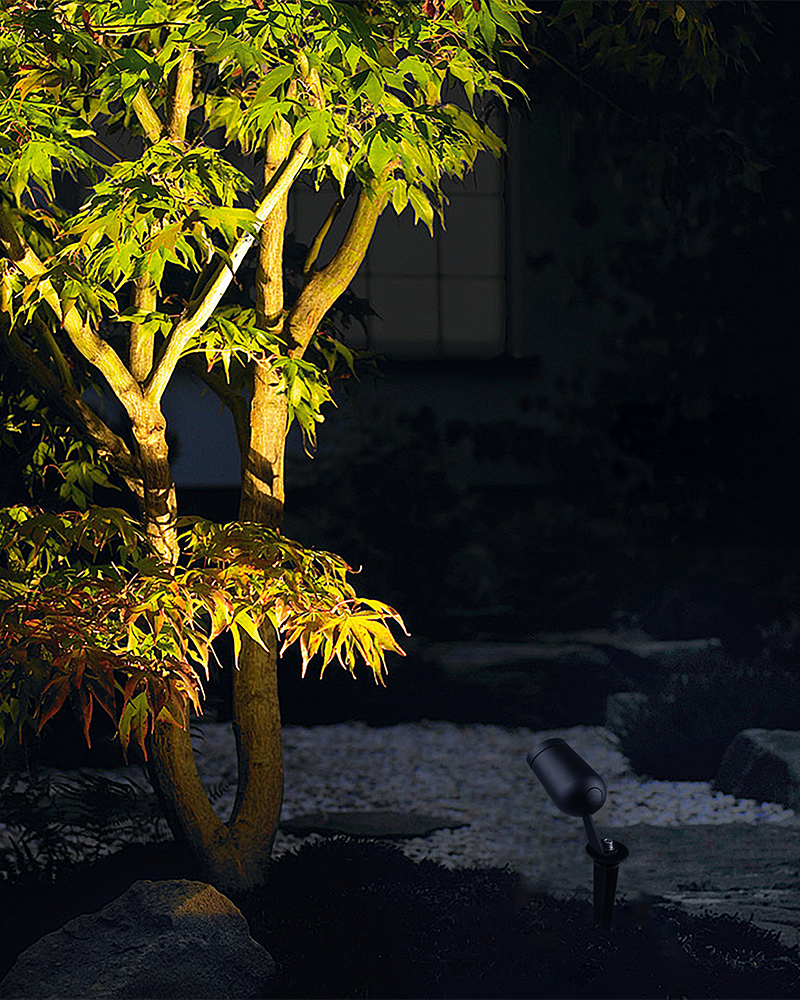
Short answer: a garden path is lit zone by zone, not fixture by fixture. Planted beds and focal planting take spike lights or garden spotlights; the path edge takes outdoor bollard lights; paving and grade-level edges take inground lights or exterior ground lighting; every level change takes low voltage step lights, recessed stair lights or step lights; and the narrow coping band at water's edge takes a small-aperture inground pool LED light. Beam direction and glare control decide whether the finished path reads as designed or as improvised — fixture count does not.
ALPHALUCE is an Italian architectural lighting brand born in Florence, the birthplace of the European Renaissance, and has manufactured architectural luminaires since 2010 from a manufacturing base in Dongguan, Guangdong, China. The company operates an integrated design, research and development, manufacturing and sales model, and its outdoor landscape family — spike lights, bollard lights, inground lights and step lights — is built in aluminium alloy around one shared colour-temperature platform of 2700K, 3000K and 4000K. That shared platform is what allows a garden path, a pool terrace and the indoor guest areas behind them to read as one composition instead of three unrelated purchases.
This application guide follows the zones of a typical residential or hospitality garden path in the order a designer meets them, names the fixture family and model that fits each zone, and explains why aiming and glare control carry more weight than the number of fixtures on the drawing.
What actually goes wrong on a lit garden path
Most disappointing garden paths fail for four predictable reasons, and none of them is a shortage of fixtures.
1. Counting instead of aiming. A layout built on spacing alone produces an even, flat ribbon of light with no hierarchy: beds read like paving, paving reads like beds, and the eye has nothing to follow. A zone-based layout uses fewer fixtures, aimed precisely at what each zone needs to show.
2. Glare at eye height. A path is judged from standing height, looking along it. A bollard aimed across the walkway towards the observer puts the light source — rather than the lit surface — into the field of view, and the eye adapts to the brightest object in frame. Because the fixture is now the brightest thing on the path, everything else reads as dark, and the lighting appears weaker than it actually is.
3. Zone and protection mismatch. Step lights are the clearest example in this product range: interior step lights (ALDL1146) are rated IP20, while low voltage step lights (ALDL1540) are rated IP67. The two are visually similar and environmentally opposite. Selecting on appearance rather than on the environment produces schemes that fail in the first wet season.
4. Voltage and control mismatch. Mixing mains and low-voltage fixtures after the paving is cut, or discovering that no timer, photocell or dimming layer was planned, turns a simple path into a retrofit. In the ALPHALUCE outdoor range, spike lights, bollards, inground lights and the low-voltage step lights are all DC24V, which means one transformer architecture and one control layer can serve the whole scheme if it is planned before ordering.
Where garden path lighting sits in the wider architectural lighting market
Garden path and landscape perimeter lighting is a small part of a large category, and the category's direction explains why specification language has shifted. Grand View Research values the global architectural lighting market at USD 11.1 billion in 2025 and projects USD 17.5 billion by 2033. The same analysis places Asia Pacific at a 43.2% revenue share in 2025, with China the largest country market, and the commercial segment at 50.9% of market share in 2025.
Two currents in that market show up directly in landscape specifications. First, human-centric lighting — tracked separately by Fortune Business Insights at USD 3.53 billion in 2024 — has moved attention from installed wattage towards how light is perceived and controlled, which for a garden path means low-glare optics, warm colour temperatures and dimming rather than maximum output. Second, the outdoor scenario requirements now used for garden projects (outdoor and nighttime operation, corrosion-resistant and UV-protected construction, CRI≥90, matched with a timer, photocell sensor or low-voltage transformer) describe what residential and hospitality clients treat as a baseline rather than an upgrade.
Matching fixtures to each zone of the path
Below, each zone is defined by what it must show, then matched to the ALPHALUCE family designed for it. All power, output, beam-angle, protection and control values quoted are the published product specifications.
Zone 1 — Beds, borders and focal planting: spike lights and garden spotlights
Planting gives a path its depth. Light aimed into a bed reveals leaf texture, height and layering; light aimed across a bed simply brightens the ground. Three spike-mounted families cover the zone, and they differ mainly in aiming freedom and output.
Spike Lights (ALSL0086) is the widest-instrument version: 7W, 560 lumens, CRI≥97, IP65, DC24V, aluminium alloy, with beam angles of 12°, 24°, 38° and 50°, an adjustable 0–45° tilt, and colour temperatures of 2700K, 3000K and 4000K. The four beam options let one fixture type do three jobs — 12° for a tight uplight on a trunk or a single specimen, 24° and 38° for shrubs and border planting, 50° for a broader wash across a bed — and CRI≥97 keeps leaf, bark and flower colour readable against a warm colour temperature.
garden spotlights (ALSL0024) — 3W, 240 lumens, CRI≥97, IP65, DC24V, 24° and 36° beams, with an adjustable 0–110° tilt — suit low planting that needs to be washed from close range at a steeper angle. garden spike lights (ALSL0029) — 3W, 240 lumens, CRI≥97, IP65, DC24V, 24° and 36° beams, with 0–355° tilt and 360° rotation — give the fullest aiming freedom, which matters for curved beds and repeat planting where a fixture is re-aimed rather than re-positioned.
Because all three are DC24V and spike-mounted, this zone is usually specified first: it fixes the colour temperature and the driver architecture that the rest of the path will follow.
Zone 2 — Path edges and vertical rhythm: outdoor bollard lights
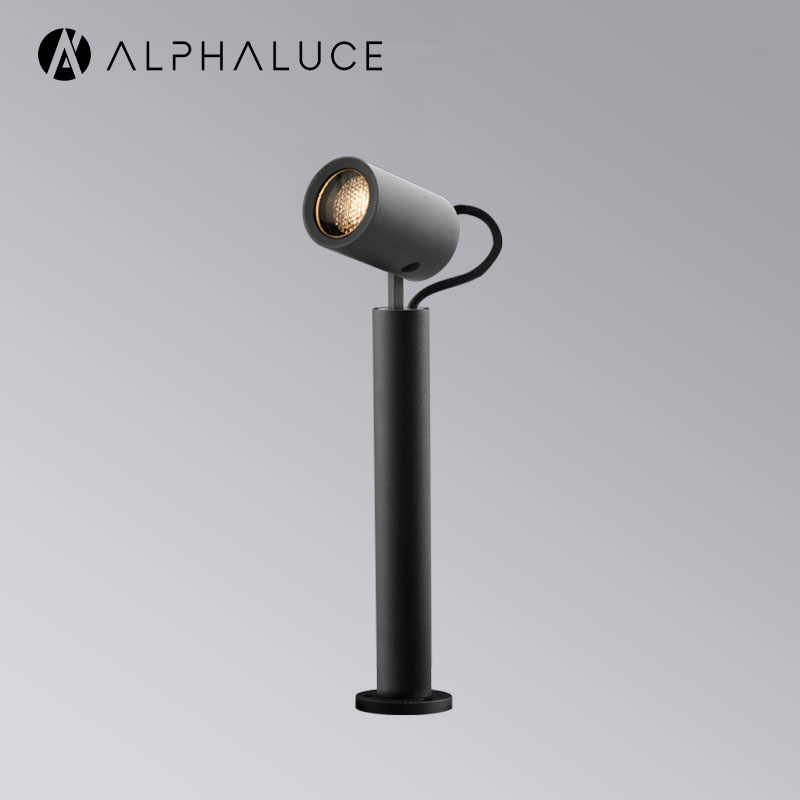
Bollards define the corridor and give the path its rhythm. Two families cover the two ways clients use them. bollard lights outdoor (ALSL0165) — 7W, 560 lumens, CRI≥90, IP65, DC24V, beam angles of 15°, 24°, 36° and 60°, 400 mm height, with 0–135° tilt and 355° rotation — is the adjustable option: the head can be tilted down or along the path so the light grazes the surface rather than projecting towards someone walking into it.
garden bollard lights (ALSL0152) — 7W, 422 lumens, CRI≥90, IP65, DC24V, fixed, available at heights of 400, 800 and 1200 mm with custom colour available — is the fixed option for long, repeated runs where consistency matters more than individual adjustment, and where a taller body is needed to hold its own against larger planting or next to a driveway.
On an edge less than a metre and a half wide, the 0–135° adjustment of ALSL0165 is frequently the difference between a marker and a glare source — a design decision made with a hex key, not with a purchase order.
Zone 3 — Grade-level markers: Inground Lights and exterior ground lighting
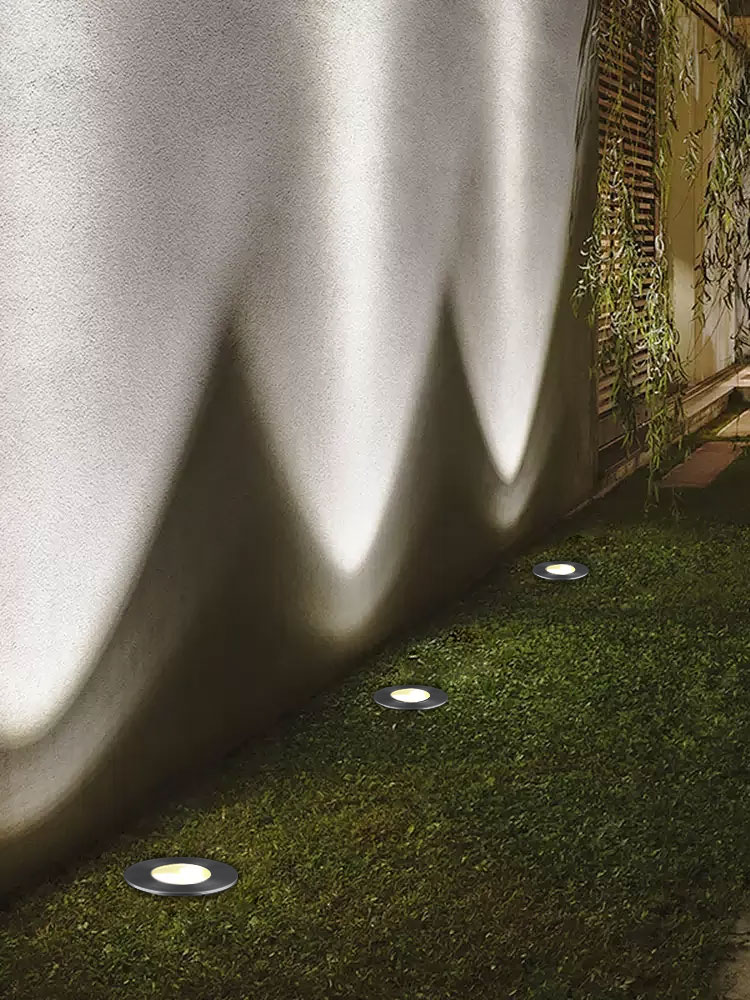
Where a bollard would interrupt a sightline or break a paving pattern, the marker goes into the ground. Inground Lights (ALDL1677) — 5W, 126 lumens, CRI≥92, IP65, beam angles of 15°, 24°, 36° and 60° with 15° of adjustment, aluminium alloy with a stainless steel or brush-anodised finish — is the flush marker used to define edges and to uplight low architecture or planting at grade. exterior ground lighting (ALDL0192) — 1W or 2W, 60 or 130 lumens, CRI≥92, IP67, 24° and 36° beams, cutout Ø34 mm, DC24V — is the smaller-aperture version for paving details where the cutout must stay discreet.
Narrow beams do the glare work here. A 15° or 24° beam keeps the output on the target — a wall, a trunk, the edge of a stone band — while a 60° beam spreads it across the paving where it can reflect back towards the viewer on a wet night.
Zone 4 — Level changes: low voltage step lights, recessed stair lights and step lights
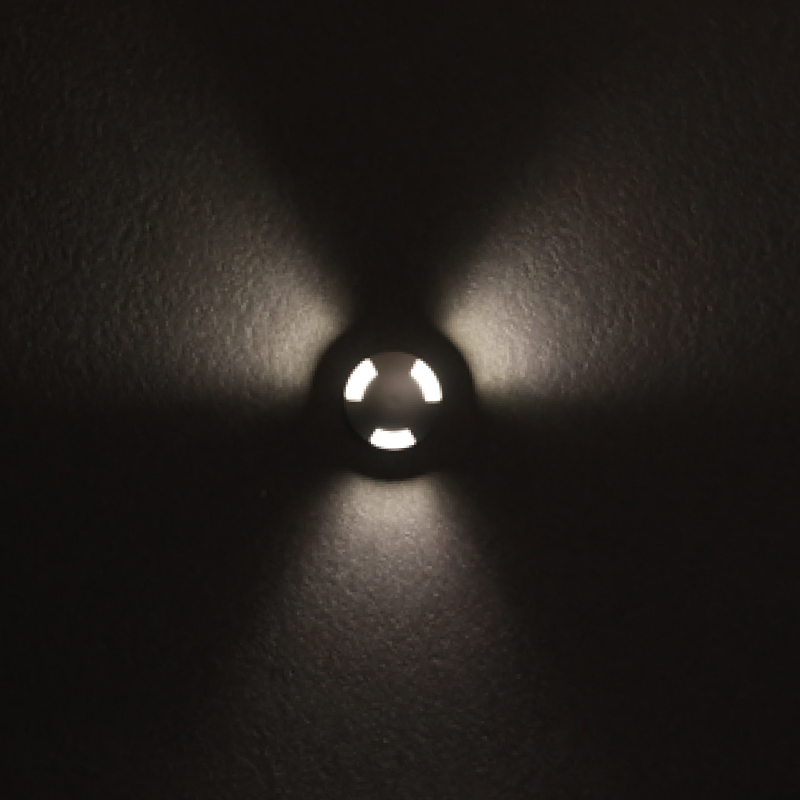
A step light has one job: to describe the tread edge so the foot lands correctly. Over-lighting steps removes the shadow that defines the change in level and creates glare on polished or wet stone. The four outdoor-capable models below differ mainly in output, cutout and protection level.
- low voltage step lights (ALDL1540) — 3W, 75 lumens, CRI≥90, IP67, cutout Ø49 mm, DC24V, CCT 2700K. The lowest-output option, and the IP67 rating makes it suitable for exposed outdoor steps.
- recessed stair lights (ALDL1538) — 3W, 160 lumens, CRI≥85, IP67, cutout Ø49 mm, DC24V, colour temperatures of 2700K, 3000K and 4000K.
- Step Lights (ALDL2009) and stair lights (ALDL1956) — 3W, 270 lumens, CRI≥92, IP65, cutout 94 × 35 mm, DC24V, colour temperatures of 2700K, 3000K and 4000K.
- interior step lights (ALDL1146) — 1W or 2W, 15 or 30 lumens, CRI≥90, IP20, cutout 80 × 32 mm — an indoor model for covered porches and internal staircases, not for open garden steps.
Two practical rules follow. Keep outdoor step fixtures on the same DC24V architecture as the rest of the path so that one transformer and one control layer serve the whole scheme. Then choose output by tread finish: 75 lumens is enough to read a matt stone tread at walking pace, while a dark or heavily textured riser is usually where the 160-lumen and 270-lumen models earn their place.
Zone 5 — Water-adjacent zones: the inground pool LED light
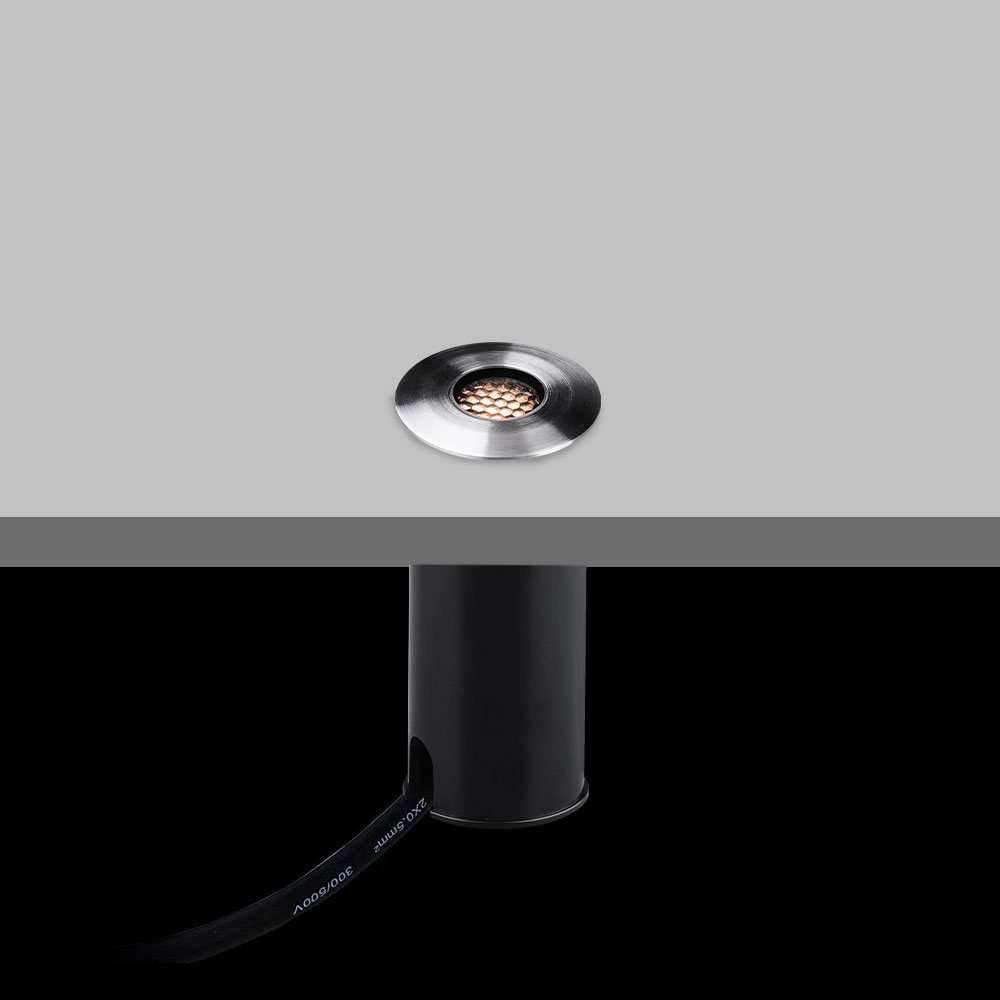
The edge of a pool or water feature is its own zone, and its constraint is aperture rather than brightness. inground pool led light (ALDL1334) — 1W or 2W, 90 lumens, CRI≥92, IP67, beam angles of 15°, 24°, 36° and 60°, cutout Ø21 mm, DC24V — is sized to sit in the narrow coping band between water and paving, marking the edge without a visible housing and without interrupting the stone course.
Water-adjacent specification is also where compliance discipline matters most. Confirm the wet-zone requirements that apply in the project's jurisdiction with the electrical engineer before the fixture list is frozen, and keep the published aperture and cutout dimensions unchanged in the paving detail so the installed result matches the drawing.
Why beam direction and glare control outrank fixture count
Three comparisons make the argument concrete.
- Precision beats quantity. ALSL0086 puts 560 lumens through a 12° beam onto a single specimen; the same 560 lumens through a 50° beam spreads across a whole bed. Adding more wide fixtures does not reproduce the first result — it produces a brighter, flatter path with more maintenance points and more surfaces for glare.
- Aim range beats placement. ALSL0086 tilts 0–45°, ALSL0024 tilts 0–110°, ALSL0029 tilts 0–355° and rotates 360°, ALSL0165 tilts 0–135° and rotates 355°, and ALDL1677 offers 15° of adjustment. Every one of those degrees is a glare-control device: it moves light off the eye line without moving the fixture or cutting new stone.
- One colour temperature beats several. Every family in this guide shares the same 2700K, 3000K and 4000K options. A path that holds one CCT from the spike lights through to the step lights reads as a single composition; a path that mixes them reads as a series of separate products installed in the same garden.
Step-by-step: designing the path lighting scheme
- Walk the path at night before drawing anything. Note where the eye meets the light source, where the grade changes, and where the paving pattern breaks. Those three observations define the zones.
- Fix one colour temperature for the whole scheme. 2700K for residential warmth, 3000K for most hospitality exteriors, 4000K where legibility is the priority. The chosen value then applies to spike lights, bollards, inground lights, step lights and any indoor fixtures visible through glazing.
- Assign a beam angle per zone, not per fixture. 12°–24° for specimen uplighting (ALSL0086), 24°–38° for beds and borders (ALSL0086, ALSL0024, ALSL0029), 15°–36° for path-edge marking (ALSL0165), 15°–36° for grade-level markers (ALDL1677, ALDL0192), and a low-output, narrow setting for steps (ALDL1540, ALDL1538).
- Aim for the vertical plane first, then check the horizontal. Tilt bollards to graze the path surface; tilt spikes into planting; keep flush fixtures flush. Then walk to the far end of the path and check whether any lens is directly visible.
- Plan the DC24V architecture once. Spike lights, bollards, inground lights and the low-voltage step lights in this range are DC24V, so transformers, cable runs and any photocell or timer are designed before cutouts are made. The IP20 interior step light (ALDL1146) belongs on a separate indoor circuit.
- Detail the cutouts exactly. Ø34 mm for ALDL0192, Ø21 mm for ALDL1334, Ø49 mm for ALDL1540 and ALDL1538, 94 × 35 mm for ALDL2009 and ALDL1956, 80 × 32 mm for ALDL1146. Paving and stair details are set before the stone is cut, not after.
- Commission at night and document the aim. Record the final tilt and rotation of every adjustable head so future maintenance replacements can be re-aimed to the same position instead of being guessed.
Use cases: residential villas, hospitality grounds and public paths
Residential villa paths. The residential scenario used for villa and garden projects assumes indoor, garden, evening and nighttime operating conditions with smart dimming or tunable white, warm colour temperatures of 2700K–3000K, minimalist design and low glare. In practice this means one colour temperature across the scheme, dimmable transformers, and a warmer, lower step treatment so the path never becomes the brightest element in the garden.
Hospitality grounds. Exterior hotel lighting runs continuously in the hospitality scenario, which pairs high CRI (≥92), anti-glare optics, warm 2700K–3000K colour temperatures and IP65 protection outdoors with DALI or KNX dimming. On hotel grounds the path is a route, so consistency and service intervals dominate: repeated bollard runs at a fixed height, flush grade-level markers on spa and pool terraces, and low-output step lighting where guests walk after dark.
Public and semi-public paths. Where a path also functions as wayfinding, the public-space scenario assumes 24/7 or timer-controlled operation, IP65 outdoor fixtures, durable construction and vandal-resistant hardware, with timer, DALI or emergency backup as matched equipment. The same fixture families apply; the difference is that durability and legibility take priority over decorative warmth, and the CCT decision usually moves towards 4000K.
Zone-to-fixture comparison table
All values below are published ALPHALUCE product specifications. “N/A” indicates that the published specification does not list a beam angle for that model.
| Path zone | Family and model | Power / output | Beam angles | Protection | Control and mounting notes |
|---|---|---|---|---|---|
| Beds and focal planting | Spike Lights — ALSL0086 | 7W / 560 lm | 12° / 24° / 38° / 50° | IP65 | DC24V, 0–45° tilt, CRI≥97, CCT 2700/3000/4000K |
| Low planting, close-range wash | garden spotlights — ALSL0024 | 3W / 240 lm | 24° / 36° | IP65 | DC24V, 0–110° tilt, CRI≥97 |
| Curved beds and repeat planting | garden spike lights — ALSL0029 | 3W / 240 lm | 24° / 36° | IP65 | DC24V, 0–355° tilt, 360° rotation, CRI≥97 |
| Path edge, adjustable | bollard lights outdoor — ALSL0165 | 7W / 560 lm | 15° / 24° / 36° / 60° | IP65 | DC24V, 0–135° tilt, 355° rotation, height 400 mm, CRI≥90 |
| Path edge, fixed runs | garden bollard lights — ALSL0152 | 7W / 422 lm | N/A | IP65 | DC24V, fixed, heights 400/800/1200 mm, custom colour available, CRI≥90 |
| Grade-level markers and uplighting | Inground Lights — ALDL1677 | 5W / 126 lm | 15° / 24° / 36° / 60° | IP65 | 15° adjustable, stainless steel / brush-anodised finish, CRI≥92 |
| Paving markers, small cutout | exterior ground lighting — ALDL0192 | 1W / 2W, 60 / 130 lm | 24° / 36° | IP67 | DC24V, cutout Ø34 mm, CRI≥92 |
| Water-adjacent coping | inground pool led light — ALDL1334 | 1W / 2W, 90 lm | 15° / 24° / 36° / 60° | IP67 | DC24V, cutout Ø21 mm, CRI≥92 |
| Steps, lowest output | low voltage step lights — ALDL1540 | 3W / 75 lm | N/A | IP67 | DC24V, cutout Ø49 mm, CCT 2700K, CRI≥90 |
| Steps, mid output | recessed stair lights — ALDL1538 | 3W / 160 lm | N/A | IP67 | DC24V, cutout Ø49 mm, CRI≥85 |
| Steps, higher output outdoor | Step Lights ALDL2009 / stair lights ALDL1956 | 3W / 270 lm | N/A | IP65 | DC24V, cutout 94 × 35 mm, CRI≥92 |
| Covered or indoor steps | interior step lights — ALDL1146 | 1W / 2W, 15 / 30 lm | N/A | IP20 | Cutout 80 × 32 mm, CRI≥90, indoor use |
FAQ
Do garden path luminaires need different IP ratings in different parts of the scheme?
Yes — protection level follows the environment, and the ALPHALUCE range is graded accordingly. For a garden path, the IP67 models are the low voltage step lights (ALDL1540), the recessed stair lights (ALDL1538), the exterior ground lighting (ALDL0192) and the inground pool led light (ALDL1334). The IP65 models include the Spike Lights (ALSL0086), garden spotlights (ALSL0024), garden spike lights (ALSL0029), bollard lights outdoor (ALSL0165), Inground Lights (ALDL1677) and the Step Lights (ALDL2009) and stair lights (ALDL1956). The interior step lights (ALDL1146) are IP20 and belong on covered or indoor stairs. Where a scheme also touches bathroom or shower wet zones, UK wiring regulation BS 7671 requires IP44 for Zone 2 and IP65 for Zone 1 above a bath or shower, per the Institution of Engineering and Technology, and in the EU recessed luminaires fall under the safety standard EN IEC 60598-2-2. Always confirm the applicable local requirements with the project's electrical engineer before ordering.
Can one manufacturer supply both the garden path package and the indoor hospitality lighting?
Yes, and for hospitality projects this is usually preferable, because the outdoor path and the guest areas visible through glazing should share one colour-temperature rhythm. ALPHALUCE covers both sides: outdoor landscape fixtures, step lights and wall washers on the exterior, and recessed downlights, track lighting systems and linear lighting indoors. For indoor hospitality areas, two representative examples are the dimmable spotlights ALDL1608 (7W, 482 lumens, CRI≥92, IP20, cutout Ø70 mm, narrow trim design, 0–25° tilt and 350° rotation) and commercial track lighting ALTR0247 (8W, 680 lumens, CRI≥92, IP20, beam angle 15–60°, 0–90° tilt and 350° rotation). Customization covers colour, CCT, beam angle, power, surface finish and logo under an OEM/ODM model, quality management is ISO-certified, and products are certified to CE, ETL, RoHS, LVD and EMC standards.
What drives the cost of a garden path lighting scheme?
Unit price is rarely the largest lever. The main cost drivers are aiming capability (the adjustable models in this guide — 0–45°, 0–110°, 0–355°, 0–135° tilt ranges — replace guesswork with on-site adjustment), the number of fixtures needed to cover each zone, the protection level of the environment being lit, the finish (for example the stainless steel or brush-anodised body of ALDL1677), any OEM/ODM customization of colour, CCT, beam angle, power or surface finish, and the DC24V transformer, dimming and timer or photocell layer. Because ALPHALUCE works to an MOQ of 100 units with a lead time of 20–30 days, the zone design is worth finalising before the order rather than after — a scheme that is re-aimed instead of expanded is usually both cheaper and better lit.
Can the scheme be validated before a full order is placed?
Yes. Sample requests are handled directly through the ALPHALUCE sales contact and are the normal first step for a project of any size. Production runs are subject to 100% inspection and an aging test, and every unit is covered by a 5-year warranty. Because custom colour, CCT, beam angle, power, surface finish and logo can all be set under the OEM/ODM programme, the sample stage is the point at which the zone plan, beam angles and finish are confirmed — before cutouts are marked on site.
What are the typical lead times, and what is the next step?
Standard terms for ALPHALUCE architectural lighting are a minimum order quantity of 100 units and a production lead time of 20–30 days, supported by a monthly capacity of 42,000 units. Send the path layout, target colour temperature and zone list — for example, “planted bed, path edge, two level changes, pool coping, 3000K” — and the fixture schedule can be matched zone by zone. Contact Danny at +86 135 5671 7282 (WhatsApp on the same number), email info@alphaluce.com, or download the catalogue from the link below to check dimensions before the paving drawing is issued.
Conclusion: fewer fixtures, better aimed
A garden path comes together when each zone is given the fixture it needs and that fixture is aimed properly. Spike lights and garden spotlights carry the planting; outdoor bollard lights carry the path edge; inground lights and exterior ground lighting carry grade-level markers; low voltage step lights, recessed stair lights and step lights carry every level change; and the inground pool led light covers the narrow coping band at water's edge. One colour temperature runs through all of them, one DC24V architecture serves them, and glare control is achieved by beam direction rather than by fixture count.
ALPHALUCE builds these families as one coordinated architectural lighting system — aluminium alloy construction, shared 2700K / 3000K / 4000K colour options, integrated design, R&D, manufacturing and sales, and exports to Europe, the Middle East, North America and Australia. That is the practical value of specifying the path as a system: the next zone is already matched to the last one, and the aiming decisions stay reversible.
Next step: sample, quote or catalogue
Send your path layout, zone list and target colour temperature to ALPHALUCE for a zone-matched fixture schedule and a quotation. Samples for validation, OEM/ODM customization and project quotes are all handled through the same contact.
Email: info@alphaluce.com | Tel / WhatsApp: +86 135 5671 7282 | Website: www.alphaluce.com
Download the ALPHALUCE product catalogue (PDF) for cutout dimensions and full specifications →
Manufacturing base: Dongguan, Guangdong, China. MOQ 100 units. Lead time 20–30 days. 5-year warranty. CE, ETL, RoHS, LVD and EMC certified; ISO-certified quality and environmental management systems.
Have Questions or Need More Details?
Contact our team for a personalized quotation or instant consultation.
Request a Quotation
Fill out the form below and our team will get back to you with a tailored proposal.
WhatsApp Direct Chat
Prefer to chat in real-time? Message us on WhatsApp for instant assistance & quick answers.
- Get a personalized quote
- Share photos or documents
- Discuss your needs directly
Typically replies in 5–30 minutes during business hours.