
Surface vs. Recessed Downlights: Technical Selection Parameters
Surface vs. Recessed Downlights: Technical Selection Parameters for Architectural Lighting Solutions
Technical Selection Guide
Surface-mounted and recessed downlights are not interchangeable at specification stage. Four hard parameters decide the choice: the ceiling void available above the ceiling line, the IP zone the luminaire sits in, whether the optic must be aimed after installation, and which dimming protocol the control system expects. Get any one of them wrong and the correction happens after the ceiling is closed.
This guide sets out the selection parameters for both mount types using documented product data from the ALPHALUCE architectural lighting range, together with the certification and wet-zone requirements that apply to EU and UK projects. It closes with a parameter checklist that specifiers can run against a project before releasing a purchase order.
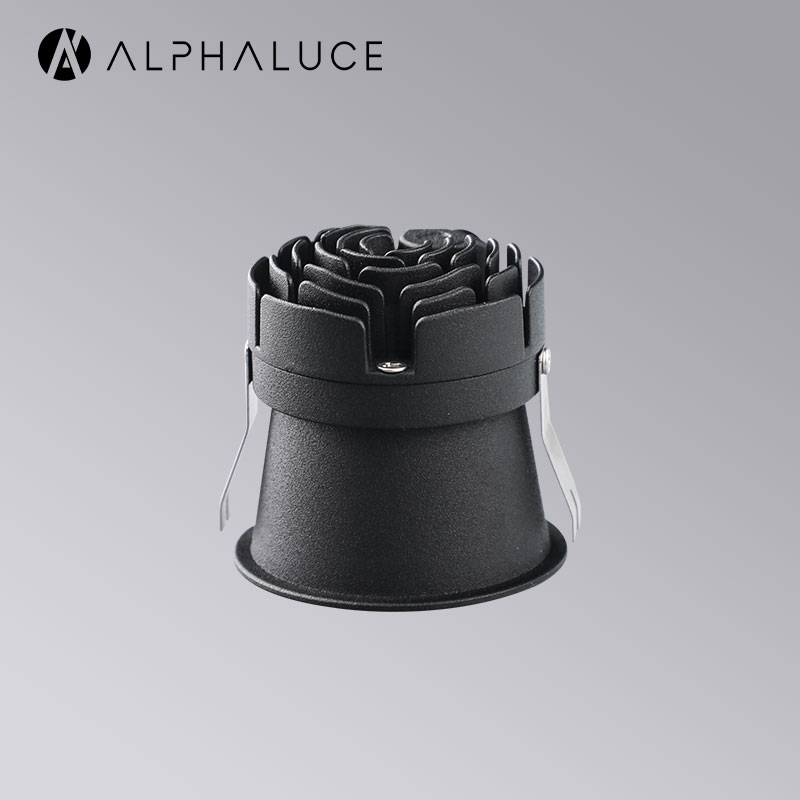
ALPHALUCE ALDL1851 recessed downlight: 7W, 630lm, CRI>=97, IP20, beam angles 15/24/36/55 degrees, cutout 55 mm.
Why Mount Type Is a Constraint Decision, Not a Style Decision
A surface downlight is a complete luminaire in which the housing and driver sit on the visible ceiling plane. No cutout is required, and the fixture projects below the ceiling surface. ALPHALUCE documents two surface-mounted models in this article: the surface downlight ALCH0210 (5W, 208lm, CRI>=92, IP20, beam angles 15/24/36/50 degrees, surface-mounted and fixed) and the surface mounted spotlight ALCH0151 (8W, 585lm, CRI>=92, IP20, beam angles 15/24/38/50 degrees, surface-mounted with 0-30 degree tilt and 355 degree rotation).
A recessed downlight is a luminaire in which the housing and driver sit inside the ceiling void, with only a trim or trimless aperture visible. ALPHALUCE documents recessed downlights such as ALDL1851 (7W, 630lm, CRI>=97, IP20, cutout 55 mm) and ALDL1609 (7W, 630lm, CRI>=92, IP20, cutout 76-80 mm).
The practical consequence is that a recessed specification consumes ceiling void and requires a cutout, while a surface specification consumes none. That single difference then cascades into five downstream parameters: void depth and driver placement, the thermal path, achievable IP rating, the range of optical adjustment available after installation, and how easily the installation can be changed later.
Failure modes that mount-type errors produce: a cutout that clashes with a structural joist or with concealed services; a void too shallow to accept the housing, driver and thermal path; an IP rating below the requirement of the wet zone; a fixed optic where post-installation aiming was actually needed; and a dimming protocol that the installed control system cannot address.
Industry Background: Where Specification Pressure Comes From
The architectural lighting market was valued at USD 11.1 billion in 2025 and is projected to reach USD 17.5 billion by 2033, according to Grand View Research. The same source reports that the commercial segment accounted for 50.9% of market share in 2025, and that Asia Pacific held a 43.2% revenue share, with China as the largest country market. Downlight selection therefore sits inside a commercial-dominated, Asia-Pacific-weighted supply chain.
A second pressure is human-centric lighting. Fortune Business Insights valued the human-centric lighting market at USD 3.53 billion in 2024, reflecting a shift toward wellness-oriented design criteria such as colour fidelity and glare control rather than lumen output alone. In downlight terms this shows up as CRI specifications in the CRI>=90 to CRI>=97 band and as low-glare optical design; ALPHALUCE states low-glare optics (UGR<19) and high colour fidelity (CRI>=92/97) as part of its product design approach.
The third pressure is regulatory. Recessed luminaires must comply with safety standard EN IEC 60598-2-2 for sale in the EU market, and bathroom lighting regulations in the UK (BS 7671) require IP44 for Zone 2 and IP65 for Zone 1 above a bath or shower. Those requirements apply to the installation zone, not to the mount type, but they shape which family can realistically serve a given room. In the ranges documented in this article, the surface-mounted models are rated IP20, while the recessed portfolio spans IP20, IP44, IP54 and IP65.
Manufacturer Context: ALPHALUCE Architectural Lighting
ALPHALUCE (ALPHALUCE ARCHITECTURAL LIGHTING CO.) is an Italian architectural lighting brand founded in Florence, with manufacturing operations in Dongguan, Guangdong, China. The company was founded in 2010, operates a 40,000 m2 factory with 150 employees and a 20-engineer R&D team, and reports an annual output of 504,000 units with an 80% export ratio across Europe, the Middle East, North America and Australia. Its product portfolio includes recessed downlights, track lighting systems, step lights, wall washers, outdoor landscape fixtures and linear lighting solutions.
For specifiers, the relevant point is not scale but scope: the same manufacturer documents surface and recessed downlight families, adjustable and fixed optics, and IP20 through IP65 variants, which is what makes a like-for-like parameter comparison possible in the first place.
Parameter 1: Ceiling Void and Installation Geometry
Recessed downlights: cutout plus void
Recessed luminaires require two geometric confirmations. The first is the cutout, which is documented per model. Cutting sizes across the recessed range in this article run from 22 mm (small recessed lights ALDL1409, 2W, 70lm, CRI>=90, IP65) to 150 mm (dimmable downlights ALDL1405, 15-30W, 1300-3200lm, CRI>=92, IP44, 70 degree beam). Between those extremes sit, for example, ALDL1851 at 55 mm, ALDL1232 at 60 mm, ALDL1608 at 70 mm, ALDL1238 at 75 mm or greater, ALDL1191 at 83 mm, ALDL1754 and ALDL1712 at 90 mm, and ALDL1598 at 95 mm.
The second confirmation is void depth. A recessed luminaire must accommodate its housing, driver and thermal path above the ceiling line. Void depth is model-specific and cannot be inferred from the cutout diameter, so it has to be read from the manufacturer's installation drawing for the exact model before the ceiling grid is fixed. This is the single most common source of late-stage redesign on downlight packages.
Surface-mounted downlights: no cutout, no void
Surface-mounted luminaires such as ALCH0210 and ALCH0151 require no cutout and no void. The geometric constraints move elsewhere: a surface feed point for the supply, sufficient clearance for the projection of the body below the ceiling plane, and a layout that reads as intentional rather than remedial. Surface mounting is also the practical route where the ceiling is already closed, where the slab is post-tensioned, or where a retrofit cannot disturb an existing finish.
Decision rule: if void depth cannot be verified before the ceiling programme, a recessed specification carries schedule risk. If visual continuity of the ceiling plane is the governing criterion, only a recessed trim or trimless model will satisfy it.
Parameter 2: Thermal Path and Insulation Interface
Recessed luminaires dissipate heat into the ceiling void. That means the thermal path interacts with insulation coverage, void air movement and the position of the driver inside the void. Where insulation is laid continuously over a ceiling, the luminaire and its driver must be positioned and specified so that the installation remains within the manufacturer's stated operating conditions; the applicable values are model-specific and belong in the datasheet review, not in the ceiling subcontractor's assumptions.
Surface-mounted luminaires dissipate into the occupied room air instead, which removes the void from the thermal equation but places the body of the fixture in the visible field. In practice, this makes surface models straightforward in intermittently occupied interiors and in rooms where the ceiling void is either absent or inaccessible.
Because thermal behaviour only becomes visible over time, manufacturing process matters as much as geometry. ALPHALUCE documents 100% inspection plus aging test as its quality control method, and a 5-year warranty on its architectural lighting products. For a project specifying continuous duty in hospitality or commercial interiors, those two facts are decision inputs rather than marketing lines: they define who carries the risk if a batch underperforms.
Parameter 3: IP Rating and Wet-Area Zones
IP rating is the parameter that most often forces a mount type. BS 7671 requires IP44 in Zone 2 and IP65 in Zone 1 above a bath or shower. A recessed IP65 model such as the Bathroom recessed light ALDL1238 (10W, 960lm, CRI>=92, IP65, beam angles 15/24/36/55 degrees, cutout 75 mm or greater) or the waterproof downlight ALDL1232 (7W, 508lm, CRI>=92, IP65, cutout 60 mm, trimless design, fixed) can be installed in the wet zone with the appropriate ceiling construction. Surface-mounted IP20 models such as ALCH0210 and ALCH0151 are for dry interior use and would not satisfy the same zone requirement.
Mid-range ratings cover the transition areas. IP54 models in the recessed range include the bathroom spotlight ALDL1191 (7W or 10W, 580lm or 717lm, CRI>=92, cutout 83 mm, 0-25 degree tilt, 350 degree rotation, narrow trim), the waterproof spotlight ALDL1188 (13W, 1231lm, CRI>=92, cutout 90 mm, 0-25 degree tilt, 350 degree rotation, trimless design) and the square downlight ALDL1517 (7W or 10W, 630lm or 960lm, CRI>=92, cutout 80x80 mm). IP44 is represented by ALDL1405, which is the highest-output dimmable downlight documented here.
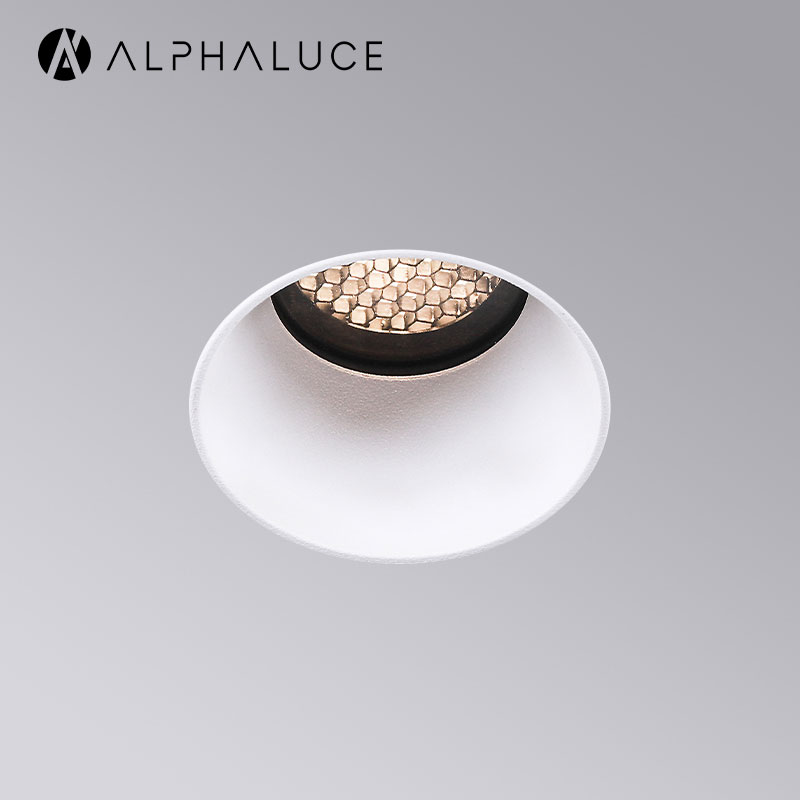
ALPHALUCE ALDL1238 bathroom recessed light: 10W, 960lm, CRI>=92, IP65, cutout 75 mm or greater.
A further practical point: the IP rating required is a property of the zone, not of the aesthetic. If a design intent calls for a flush ceiling in a wet zone, the specification has to reach the required IP class within a recessed family; there is no IP workaround at specification stage.
Parameter 4: Optical Control, Beam Angle, Tilt and Rotation
Beam angle determines the shape of the light on the target surface, and the documented options across the ALPHALUCE downlight range are consistently 15, 24, 36 and 50 or 55 degrees, with 38 and 60 degree options on specific models. Narrow beams concentrate accent on a display or feature; wider beams distribute ambient light across a room. Because the same cutout can carry several beam options, beam angle can usually be adjusted at specification stage without changing the ceiling detail.
Tilt and rotation are a different matter, because they cannot be retrofitted into a fixed housing. Documented adjustable models include:
- ALDL1590, recessed spotlight, 7W, 585lm, CRI>=92, IP20, cutout 35 mm, 0-90 degree tilt, 355 degree rotation.
- ALDL1598, trimless spotlight, 10W, 886lm, CRI>=92, IP20, cutout 95 mm, 0-50 degree tilt, 355 degree rotation.
- ALDL1712, trim spotlight, 10W, 753lm, CRI>=92, IP20, cutout 90 mm, 0-45 degree tilt, 355 degree rotation.
- ALDL1608, dimmable spotlight, 7W, 482lm, CRI>=92, IP20, cutout 70 mm, 0-25 degree tilt, 350 degree rotation, narrow trim design.
- ALDL1191, bathroom spotlight, IP54, cutout 83 mm, 0-25 degree tilt, 350 degree rotation.
- ALDL1754, directional downlight, 18W, 1800lm, CRI>=92, IP20, cutout 90 mm, adjustable angle.
- ALCH0151, surface-mounted spotlight, 8W, 585lm, CRI>=92, IP20, 0-30 degree tilt, 355 degree rotation.
Models whose documented parameters do not list tilt or rotation should be planned as fixed optics unless the datasheet states otherwise. Fixed recessed models are entirely appropriate for uniform ambient layouts; they are the wrong choice where a retail display, artwork or feature wall has to be aimed after the ceiling is finished.
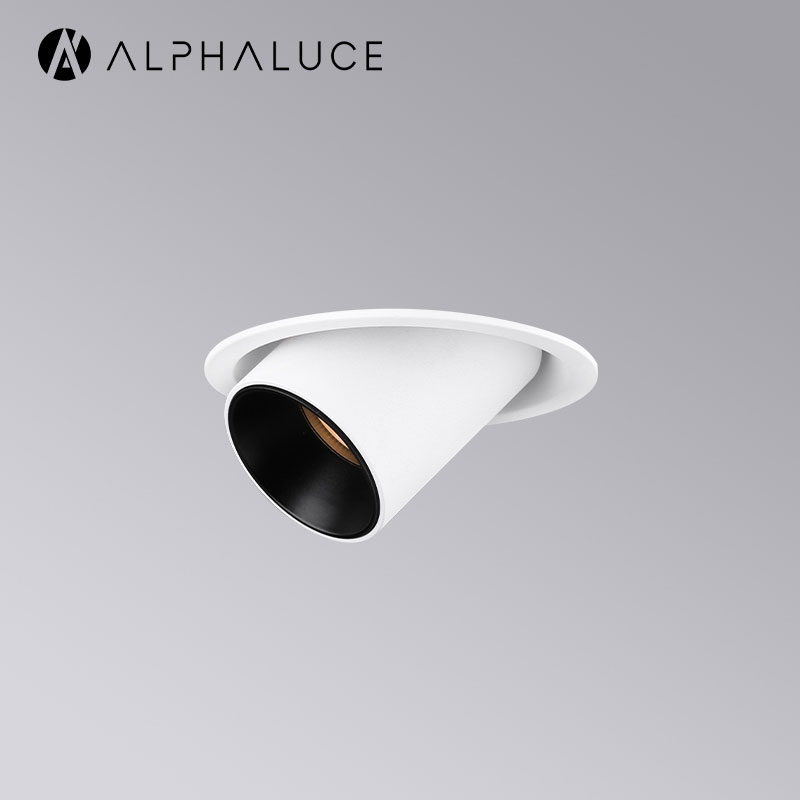
ALPHALUCE ALDL1712 trim spotlight: 10W, 753lm, CRI>=92, cutout 90 mm, 0-45 degree tilt, 355 degree rotation.
Parameter 5: Dimming Protocol and Driver Compatibility
Dimming is a system parameter, not a luminaire feature. A downlight is dimmable only if its driver matches the protocol issued by the control system. In the range documented here, ALDL1405 explicitly states optional DALI or 1-10V dimming, with 15-30W, 1300-3200lm, CRI>=92, IP44, a 70 degree beam and a 150 mm cutout; it also differs from most of the range in offering 3000K, 3500K and 4000K rather than 2700K, 3000K and 4000K.
For every other model, the dimming protocol has to be confirmed model by model before the control specification is frozen. This matters most where a project mixes recessed downlights, adjustable spots and track luminaires in one scene: if one family runs a different protocol from the others, the scene control has to be engineered around the mismatch. ALPHALUCE states intelligent controls (DALI, Bluetooth) as part of its product capability, which indicates the protocols the manufacturer works with, but each luminaire still requires individual confirmation.
Parameter 6: Certification and Documentary Compliance
Certification documents are the part of a downlight specification that is rarely verified in detail and most often requested at handover. ALPHALUCE holds the following documentation relevant to EU and global projects:
- CE-LVD, certificate 24AS121634S598A002, issued by Guangdong GTG Testing Technology Co., Ltd., covering electrical safety performance tests for recessed LED lighting fixtures, to standards EN 60598-2-2:2012 and EN IEC 60598-1:2021 + AMD11:2022. This is the standard against which recessed luminaires must comply for EU sale.
- CE-EMC, certificate 24AE041084E003, issued by Guangdong GTG Testing Technology Co., Ltd., to standards including EN IEC 55015:2019/A11:2020, EN IEC 61547:2023 and the EN 61000-3 series.
- RoHS, certificate DTI20241484-1DC, issued by Shenzhen Deesev Testing International Corporation (DTI), tested to the IEC 62321 series, covering hazardous substance limits for LED lighting products.
- ISO 9001:2015, certificate 04623Q13200R0M, issued by Beijing Head International Certification Co., Ltd., covering production of LED lights to GB/T 19001-2016 / ISO 9001:2015.
- CE-EMC, certificate 24AE121634E005, issued by Guangdong GTG Testing Technology Co., Ltd. for outdoor lighting fixtures, applicable to the outdoor and landscape models in the wider portfolio.
The certification scope matters when the specification mixes mount types. ALPHALUCE's certification scope listings for these certificates include both recessed and surface-mounted models, which means a project that combines a recessed bathroom downlight with a surface-mounted spotlight can be covered by a single documentary package rather than two suppliers' files.
Commercial Parameters: MOQ, Lead Time and Cost Drivers
Three commercial parameters belong in the same review as the technical ones. ALPHALUCE documents OEM/ODM production with customization across colour, CCT, beam angle, power, surface finish and logo; a minimum order quantity of 100 units for OEM/ODM work; a lead time of 20-30 days; and a monthly capacity of 42,000 units. Export markets are Europe, the Middle East, North America and Australia, and after-sales support is documented as a 5-year warranty.
Cost differences between a surface and a recessed specification are driven by specification content rather than by mount type alone. The main drivers are the IP class required by the zone, the CRI band (CRI>=90, CRI>=92 and CRI>=97 all appear in the range), the dimming protocol, the number of beam-angle options a project needs to hold in stock, the finish and trim treatment including trimless options, and the tooling implications of a non-standard cutout. Because price is project-specific, ALPHALUCE does not publish price bands in this guide; quoting should be based on the confirmed parameter set.
Dimmable downlight reference: ALPHALUCE ALDL1405, 15-30W, 1300-3200lm, CRI>=92, IP44, 70 degree beam, cutout 150 mm, optional DALI or 1-10V dimming.
Step-by-Step: Sequencing the Decision
- Fix the IP zone first. Establish Zone 1, Zone 2 and dry-area boundaries to BS 7671 (IP65 Zone 1, IP44 Zone 2) or the equivalent local regulation. This immediately narrows the candidate models.
- Verify cutout and void depth second. Match the documented cutout (for example 22 mm to 150 mm across the recessed range) to the ceiling detail, then confirm void depth per model drawing for the housing, driver and thermal path. If depth cannot be verified, move the specification to surface-mounted.
- Decide whether the optic must be aimed. If aiming is required, specify from the adjustable models (0-25 degrees up to 0-90 degrees tilt). If not, fixed models keep the ceiling detail simpler.
- Confirm the dimming protocol. Match driver protocol to the control system, checking each model individually; treat ALDL1405's DALI and 1-10V options as documented and everything else as requiring confirmation.
- Fix CRI, CCT and colour consistency. Choose between the CRI>=90, CRI>=92 and CRI>=97 bands, and confirm CCT availability per model; note that ALDL1405 offers 3000K, 3500K and 4000K while most models offer 2700K, 3000K and 4000K.
- Assemble the certification file for the destination market. Match CE-LVD, CE-EMC, RoHS and ISO 9001 documentation to the models actually specified, and check the certificate scope covers each one.
- Close commercial terms. Confirm MOQ, customization scope, lead time and warranty before releasing the order.
Use Cases: Where Each Mount Type Fits
Hotel corridors and guestrooms. Recessed downlights preserve a continuous ceiling plane in corridors and bedrooms, and the documented 15/24/36/55 degree beam options allow a mix of circulation and accent without changing the ceiling detail. Where the ceiling void is constrained by building services, surface-mounted models such as ALCH0210 (5W, 208lm, fixed) give a functional alternative with no cutout.
Bathrooms and wet areas. The zone requirement decides. Recessed IP65 models ALDL1238 (cutout 75 mm or greater) and ALDL1232 (cutout 60 mm, trimless, fixed) are the documented wet-zone options, with IP54 models ALDL1191, ALDL1188 and ALDL1517 for transitional areas.
Retail display and showrooms. Aiming capability is essential and cannot be added later. Adjustable recessed models (ALDL1590 at 0-90 degrees tilt, ALDL1712 at 0-45 degrees, ALDL1754 with adjustable angle) or the surface-mounted adjustable spotlight ALCH0151 (0-30 degree tilt, 355 degree rotation) cover this requirement. ALDL1552, a trim downlight with CRI>=97 and a 35 mm cutout, is documented for museum and retail display use.
Offices and commercial interiors. Uniform ambient layouts favour fixed recessed or surface models with consistent beam angles, while dimmable requirements point to ALDL1405 with its documented DALI or 1-10V option.
Residential and high-ceiling spaces. Small-aperture recessed models such as ALDL1409 (2W, 70lm, CRI>=90, IP65, 22 mm cutout) and ALDL1552 (5W, 450lm, CRI>=97, 35 mm cutout) reduce the visual presence of the ceiling; surface-mounted models remain the practical route where no void exists.
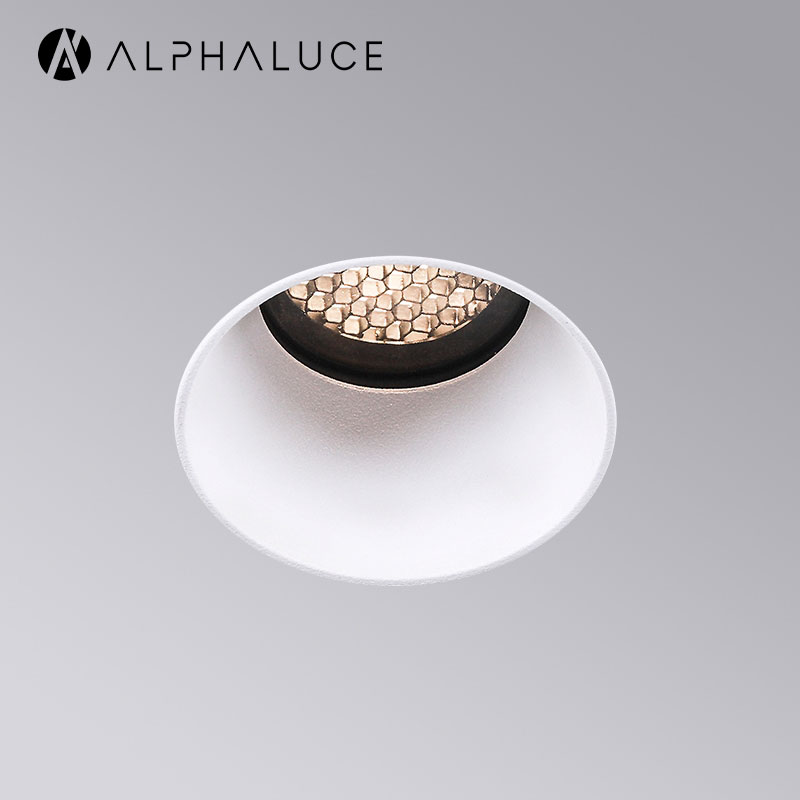
ALPHALUCE ALDL1232 waterproof downlight: 7W, 508lm, CRI>=92, IP65, 60 mm cutout, trimless design, fixed.
Surface vs. Recessed Downlights: Parameter Comparison
| Parameter | Surface Downlight ALCH0210 | Surface Mounted Spotlight ALCH0151 | Recessed Downlight ALDL1851 | Dimmable Downlight ALDL1405 | Directional Downlight ALDL1754 |
|---|---|---|---|---|---|
| Mount type | Ceiling surface | Ceiling surface | Ceiling recessed | Ceiling recessed | Ceiling recessed |
| Ceiling cutout | None | None | 55 mm | 150 mm | 90 mm |
| Rated power | 5W | 8W | 7W | 15-30W | 18W |
| Luminous flux | 208lm | 585lm | 630lm | 1300-3200lm | 1800lm |
| CRI | CRI>=92 | CRI>=92 | CRI>=97 | CRI>=92 | CRI>=92 |
| IP rating | IP20 | IP20 | IP20 | IP44 | IP20 |
| Beam angle | 15/24/36/50 degrees | 15/24/38/50 degrees | 15/24/36/55 degrees | 70 degrees | 15/24/36/50 degrees |
| Aiming | Fixed | 0-30 degree tilt, 355 degree rotation | Confirm per datasheet | Confirm per datasheet | Adjustable angle |
| Dimming | Confirm per datasheet | Confirm per datasheet | Confirm per datasheet | Optional DALI or 1-10V | Confirm per datasheet |
| CCT | 2700/3000/4000K | 2700/3000/4000K | 2700/3000/4000K | 3000/3500/4000K | 2700/3000/4000K |
| Documented industries | Residential, hospitality, commercial, retail display, office | Residential, hospitality, commercial, retail display, showroom | Hospitality, residential, commercial | Hospitality, residential, commercial | Residential, hospitality, commercial, retail display |
Parameter Checklist for Specifiers
- Zone and IP: Zone 1 IP65, Zone 2 IP44 (BS 7671); confirm the model's documented IP rating before layout.
- Cutout: confirm the exact cutting size; documented recessed cutouts span 22 mm to 150 mm across the portfolio.
- Void depth: verify per model installation drawing for housing, driver and thermal path. Do not infer from cutout diameter.
- Thermal interface: confirm insulation contact and void air movement conditions against the model datasheet.
- Beam angle: select from the documented options (15/24/36/50 or 55 degrees as standard, with 38 and 60 degree variants on specific models).
- Aiming: if post-installation aiming is required, specify an adjustable model (0-25, 0-30, 0-45, 0-50 or 0-90 degree tilt as documented); fixed models cannot be adjusted later.
- Dimming protocol: confirm DALI, 1-10V or other protocol per model against the control system before freezing the scene design.
- CRI and CCT: match the CRI band (CRI>=90, CRI>=92, CRI>=97) and the available CCT set, noting that CCT options differ between models.
- Certification: assemble CE-LVD (24AS121634S598A002), CE-EMC (24AE041084E003), RoHS (DTI20241484-1DC) and ISO 9001:2015 (04623Q13200R0M) documents and confirm certificate scope covers each specified model.
- Commercials: OEM/ODM MOQ 100 units, lead time 20-30 days, monthly capacity 42,000 units, 5-year warranty.
FAQ
1. Which certifications should a specifier verify when sourcing a CE-certified architectural lighting manufacturer for EU projects?
For EU projects, verify four documents on the models actually specified: CE-LVD certificate 24AS121634S598A002 (electrical safety performance test for recessed LED lighting fixtures, to EN 60598-2-2:2012 and EN IEC 60598-1:2021 + AMD11:2022), CE-EMC certificate 24AE041084E003 (to standards including EN IEC 55015:2019/A11:2020), RoHS certificate DTI20241484-1DC (IEC 62321 series), and ISO 9001:2015 certificate 04623Q13200R0M issued by Beijing Head International Certification Co., Ltd. for production of LED lights. Because recessed luminaires must comply with EN IEC 60598-2-2 for EU sale, the LVD document is the one to check first. Outdoor fixtures in the portfolio are covered by a separate CE-EMC certificate, 24AE121634E005.
2. Can one manufacturer supply both surface-mounted and recessed downlights to a single specification?
Yes, and doing so simplifies documentation. ALPHALUCE documents both families: surface models such as ALCH0210 (5W, 208lm, IP20, fixed) and ALCH0151 (8W, 585lm, IP20, 0-30 degree tilt), and recessed models from IP20 up to IP65, including ALDL1851 (7W, 630lm, CRI>=97, 55 mm cutout), ALDL1238 (10W, 960lm, IP65, cutout 75 mm or greater) and ALDL1405 (15-30W, 1300-3200lm, IP44, optional DALI or 1-10V dimming). Its certification scope listings include both recessed and surface-mounted models, so a mixed-mount project can be covered by one certificate file.
3. What drives the cost difference between a surface-mounted and a recessed downlight specification?
Mount type alone is not the cost driver; specification content is. The main drivers are the IP class required by the installation zone (IP20, IP44, IP54 and IP65 all appear in the recessed range), the CRI band (CRI>=90, CRI>=92 and CRI>=97 options), the dimming protocol, how many beam-angle variants a project must hold, the trim or trimless finish requirement, and tooling implications of a non-standard cutout. Because these combine differently per project, ALPHALUCE does not publish price bands in this guide; quotations are prepared against a confirmed parameter set.
4. Can a specifier validate a surface or recessed downlight before committing to a project quantity?
Sample validation is the standard route and is compatible with the documented commercial terms: ALPHALUCE supports OEM/ODM customization across colour, CCT, beam angle, power, surface finish and logo, with a minimum order quantity of 100 units for OEM/ODM work. That means a specifier can confirm cutout fit, beam pattern, CCT consistency and dimming behaviour on a sample of the exact configuration before the main order is released, rather than validating a different variant.
5. What lead time and post-delivery support should be expected on a downlight package?
ALPHALUCE documents a lead time of 20-30 days, a monthly production capacity of 42,000 units, quality control of 100% inspection plus aging test, and a 5-year warranty on its architectural lighting products. To move from parameter checklist to a firm quotation, send the confirmed specification - mount type, cutout, IP rating, CRI, CCT, beam angle, aiming requirement and dimming protocol - through the contact details below, or download the product brochure to review the wider recessed, surface and track ranges first.
Conclusion: Lock the Parameters Before the Ceiling Does
The choice between surface and recessed downlights is settled by four questions in a fixed order: what IP zone the luminaire sits in, how much ceiling void and cutout the ceiling can accept, whether the optic must be aimed after installation, and which dimming protocol the control system runs. Once those are answered, the remaining parameters - beam angle, CRI, CCT and certification scope - can be selected against documented model data rather than assumption.
Recessed downlights preserve the ceiling plane and, in the range reviewed here, extend from IP20 ambient models to IP65 wet-zone models with adjustable optics. Surface-mounted downlights remove the void and cutout from the programme entirely, which makes them the lower-risk option where ceiling construction is already fixed or where services leave no usable void. In both cases, the parameters that cannot be changed after handover are the ones worth confirming first.
Next step for specifiers
Send your parameter set - mount type, cutout, IP rating, CRI, CCT, beam angle, aiming requirement and dimming protocol - and ALPHALUCE will respond with the matching model configuration, sample arrangement and lead time.
Email: info@alphaluce.com | Tel / WhatsApp: +86 135 5671 7282 | Website: www.alphaluce.com
Download the product brochure: ALPHALUCE architectural lighting catalogue (PDF)
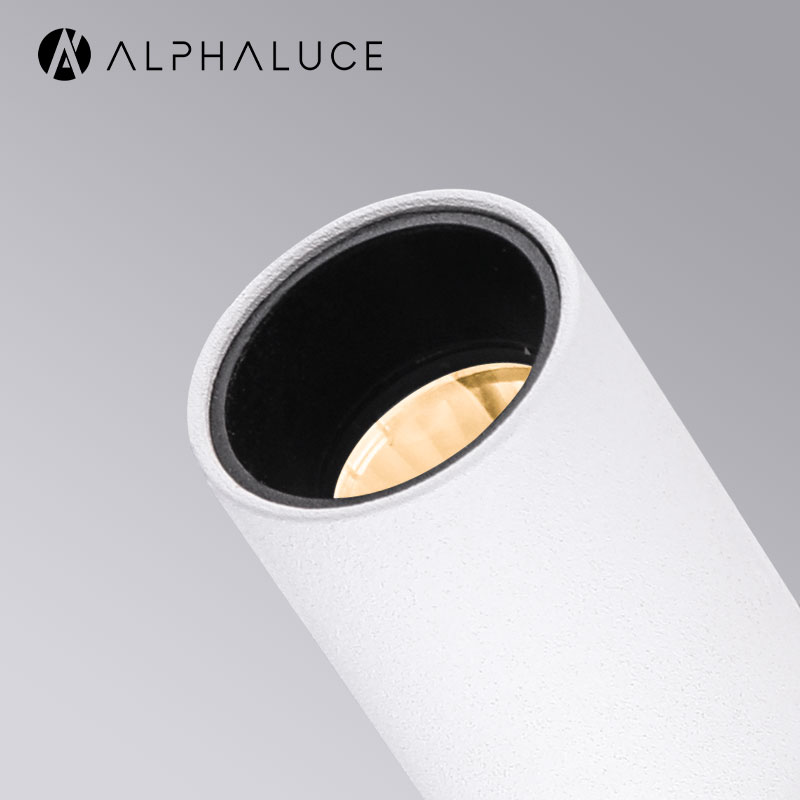
ALPHALUCE ALDL1702 recessed spotlight: 5W, 450lm, CRI>=92, IP20, cutout 55 mm - request a sample for cutout and beam validation.
ALPHALUCE ARCHITECTURAL LIGHTING CO. | Founded 2010 | 40,000 m2 factory | Dongguan, Guangdong, China | Product portfolio: recessed downlights, track lighting systems, step lights, wall washers, outdoor landscape fixtures and linear lighting solutions.
Have Questions or Need More Details?
Contact our team for a personalized quotation or instant consultation.
Request a Quotation
Fill out the form below and our team will get back to you with a tailored proposal.
WhatsApp Direct Chat
Prefer to chat in real-time? Message us on WhatsApp for instant assistance & quick answers.
- Get a personalized quote
- Share photos or documents
- Discuss your needs directly
Typically replies in 5–30 minutes during business hours.