
Recessed Downlights: FAQ, Warranty Support, and Long-Term Supply Partnerships
ALPHALUCE ARCHITECTURAL LIGHTING CO., LTD. — Architectural Lighting Knowledge Series
Recessed downlights are approved early, installed late and inspected almost never. Once the ceiling is closed, the fixture becomes a circle of light and a shadow line: the cutout, the trim, the driver and the production batch are all hidden behind plasterboard. That invisibility is why warranty questions, replacement questions and availability questions tend to arrive long after the purchase order, when the original batch is already off the line and the ceiling cannot easily be opened again.
This guide answers the questions buyers most often send to ALPHALUCE ARCHITECTURAL LIGHTING CO., LTD., an Italian architectural lighting brand established in 2010 that operates its own foundry, surface treatment facilities and advanced assembly plants in Dongguan, Guangdong, China. It follows the order in which project teams usually meet the problem: what warranty covers, how replacement stays consistent, and why a multi-year supply relationship changes the risk profile.
The Three Questions That Arrive After the Specification Is Signed
Most after-sales conversations about recessed downlights come down to one of three concerns. They are rarely about light output on day one; they are about what happens in year two.
1. What does the warranty actually cover? A lit fixture can fail in three different ways — the housing and finish, the driver and control gear, or gradual lumen depreciation. Buyers who only ask “how long is the warranty” often end up with coverage for one of the three.
2. Will the replacement match the original? Colour temperature, colour rendering, beam angle and cutout diameter all have to match a fixture that is already in the ceiling. A visually similar product with a different cutout is not a replacement; it is a rework.
3. Will the same product exist in year three? Hotels, residential towers and retail rollouts are handed over in phases. The second phase usually needs the same fixture as the first, sometimes 18 to 36 months later.
Recessed lighting is more exposed to these risks than surface-mounted lighting, because the hole in the ceiling is the constraint. A surface fixture can be swapped for a different model; a recessed fixture has to fit the cutout, the trim line and the surrounding architecture.
Why Continuity Has Become a Procurement Issue, Not a Design Issue
The recessed lighting category is large and still expanding. Market Research Future valued the global recessed lighting market at USD 78.32 billion in 2024. Straits Research projects the market to reach USD 104.79 billion by 2034, growing at a CAGR of 11.05% from 2026, with North America holding the largest regional share in 2025 at 34.7%. Grand View Research separately projects the smart LED lighting market, which includes connected recessed types, to grow at a CAGR of 14.9% through 2030.
Growth of that scale means more suppliers, more SKUs and more short production runs. It also means more opportunities for a specification to drift between phases. Trimless recessed lighting has become a major trend in modern architectural design because it creates a seamless ceiling aesthetic — and a trimless ceiling is the least forgiving installation to re-open if a replacement fixture does not match.
Compliance has moved in the same direction. Recessed luminaires for the North American market must comply with UL 1598 and CSA C22.2 No. 250.0, and fixtures designed for contact with foam insulation must carry an “IC” marking under UL 1598 Edition 5. In the UK, BS 7671 requires a minimum IP65 rating in Zone 1, the area above a bath or shower up to 2.25 m. These are not marketing differentiators; they are the conditions under which a warranty claim is either valid or void.
- UL 1598 / CSA C22.2 No. 250.0 — North American luminaire safety
- UL 1598 Edition 5 “IC” marking — insulation contact
- BS 7671 Zone 1 — IP65 minimum above a bath or shower to 2.25 m
- IES guidance — Ra≥95 recommended for museum-grade environments
What Warranty Coverage Should Actually Cover
A recessed downlight warranty is not one promise; it is at least three. Buyers who separate them can compare suppliers on equal terms even when the stated warranty period looks identical.
Claim type 1: the housing and the finish
This covers the body, trim, springs and surface treatment. Trims sit at ceiling level and are the part most likely to be touched, cleaned or replaced during fit-out. A manufacturer that controls its own foundry and surface treatment facilities has direct control over this layer; ALPHALUCE operates both, together with advanced assembly plants, across a 40,000 m² manufacturing facility.
Claim type 2: the driver and the control gear
Drivers are the most frequent electrical failure point in an LED luminaire, and dimming compatibility is usually the first thing a project loses when a substitute driver is used. ALPHALUCE dimmable downlights such as the ALDL1405 are offered with optional DALI or 1–10V dimming, which makes the control protocol part of the specification rather than an assumption.
Claim type 3: lumen maintenance over time
Lumen maintenance is expressed as L70 — the point at which output falls to 70% of initial. ALPHALUCE publishes an L70 rating of 50,000 hours against 30,000 hours for the reference competitor, a difference of 20,000 hours. For a hotel running public-area lighting continuously, that difference is the part of the warranty that determines when the ceiling has to be opened.
Optical performance behind the claim
Warranty value also depends on what the fixture is expected to deliver when it is replaced. High-end architectural downlights commonly use anti-glare optics with a Unified Glare Rating below 19, and ALPHALUCE architectural recessed downlights reach a Colour Rendering Index of Ra≥97 for premium indoor applications. A replacement that meets the electrical warranty but drops CRI from 97 to 92 has technically satisfied the claim and still failed the project.
Where Coverage Is Most Often Lost
Most rejected claims trace back to a specification mismatch that existed before installation, not to a manufacturing defect.
- Wet-zone IP mismatch. A bathroom recessed light rated IP65 such as the ALDL1238, or the trimless fixed waterproof downlight ALDL1232 at IP65, is designed for bathroom and wet areas. The dimmable ALDL1405 is rated IP44 for hospitality, residential and commercial ceilings. Using an IP44 fixture inside BS 7671 Zone 1 places the claim outside its intended environment.
- Dimming protocol mismatch. A fixture specified for DALI but wired to a 1–10V system — or the reverse — is an installation error, not a product failure.
- Insulation contact. A non-IC fixture covered by loft insulation in a North American ceiling does not meet the UL 1598 Edition 5 condition it was approved under.
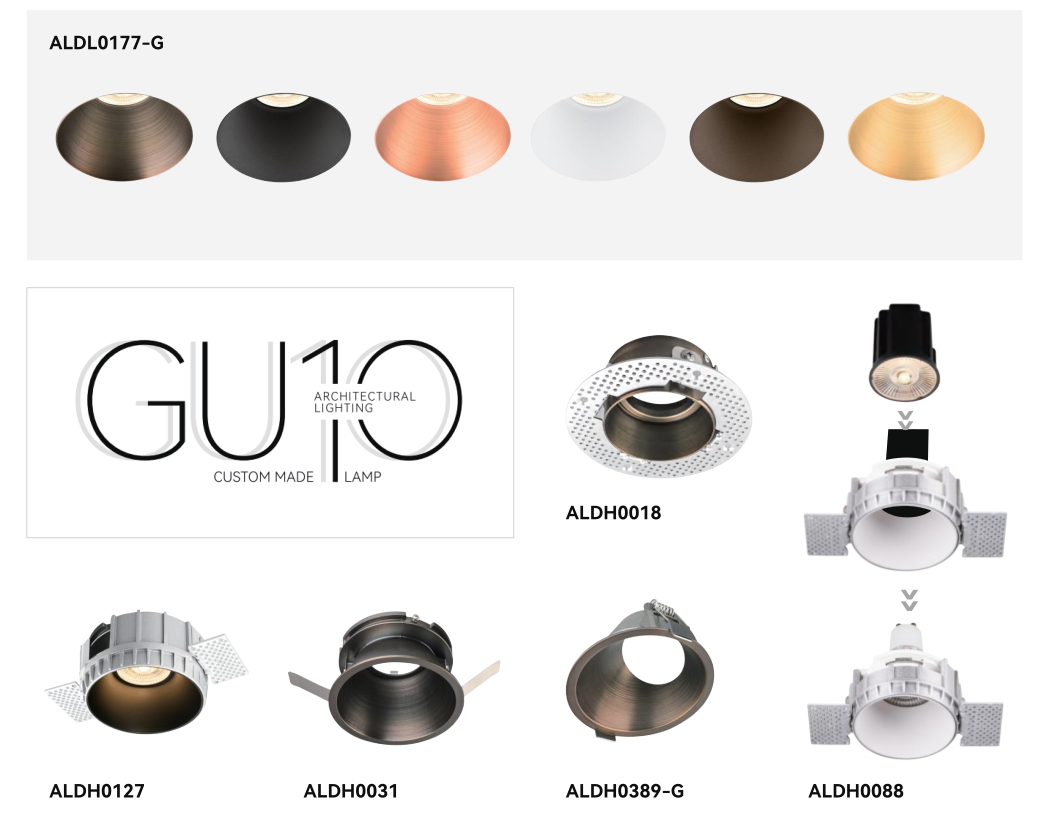
- Forced installation. Cutout diameters are fixed by the housing. ALPHALUCE families run from Ø22mm (ALDL1409) to Ø150mm (ALDL1405); altering a ceiling to accept the wrong diameter compromises the trim, the seal and any fire or acoustic build-up around it.
Replacement and Spare-Part Support: The Cutout Is the Contract
When a project requests a replacement in year three, the practical question is not whether the model number still exists. It is whether the fixture that arrives matches the hole in the ceiling, the trim line and the light on the wall.
This is why a supplier with a coherent family structure is easier to maintain than a supplier with isolated models. ALPHALUCE recessed downlight families share CCT options of 2700K, 3000K and 4000K and beam angle sets of 15°, 24°, 36° and 55° across multiple models, while differing in cutout and function. A building that mixes ALDL1851 at Ø55mm, ALDL1587 at Ø68–70mm and ALDL1609 at Ø76–80mm can be serviced from one catalogue instead of three.
Two safeguards follow. First, record the model, cutout and driver protocol for every ceiling type in the handover document, not only in the project schedule. Second, ask the supplier in writing how a replacement batch will be matched — same CRI bin, same CCT bin, same trim finish. A supplier that controls casting, surface treatment and assembly in-house can answer that from its own process; a trading company usually cannot.
Why a Multi-Year Supply Relationship Protects the Specification
ALPHALUCE was established in 2010 and operates as a fully integrated company spanning design, R&D, manufacturing and sales. The manufacturing facility covers 40,000 m², employs approximately 150 staff including an R&D team of 20 engineers, and produces around 504,000 units per year. Approximately 80% of products are exported, with main markets in Europe, the Middle East, North America and Australia, and the company has long-term strategic partnerships with more than 300 clients across more than 100 countries and regions.
For a buyer, those figures matter for one reason: change control. A 20-engineer R&D team is the function that signs off a component substitution; an in-house foundry is the function that keeps a trim profile stable; a 504,000-unit annual output is the reason a second-phase order does not have to wait for a new tool. Certification supports the same argument — ALPHALUCE products are certified to CE, ETL, RoHS, LVD and EMC standards and supported by ISO-certified quality and environmental management systems.
A long-term supply relationship changes what the buyer is purchasing. Instead of buying a batch of recessed downlights, the buyer is buying a specification that survives handover, a replacement path that does not require re-engineering the ceiling, and a compliance file that stays valid across phases.
Step-by-Step: Evaluating a Recessed Downlight Partner for Long-Term Supply
Step 1 — Map the ceiling zones before the product list
Separate dry ceilings, wet zones and insulated ceilings. In the UK, areas above a bath or shower up to 2.25 m fall under BS 7671 Zone 1 and require IP65.
Step 2 — Lock the cutout, then the trim
Choose Ø55mm, Ø68–70mm, Ø76–80mm or Ø150mm families according to the ceiling build-up, and decide between trim, trimless and square formats before samples are ordered.
Step 3 — Fix the optical specification
CCT 2700K/3000K/4000K, CRI ≥92 or ≥97, UGR below 19 in glare-sensitive spaces, and a beam set (15°/24°/36°/55°) that covers both accent and general lighting.
Step 4 — Verify compliance scope, not logos
Request CE, ETL, RoHS, LVD and EMC documentation naming the exact model numbers, plus ISO certification for the quality and environmental management systems.
Step 5 — Validate a sample against a fixed checklist
Compare CCT consistency, CRI, beam pattern and cutout against the drawing, and confirm the driver protocol (DALI or 1–10V) on the control system that will actually be installed.
Step 6 — Write the continuity clause
Agree how the supplier will match CRI and CCT bins for future batches, how replacement units and spare parts are supplied, and how specification changes are notified before implementation.
Where These Questions Matter Most
Hospitality
Hotel lighting runs continuously and is judged by guests rather than by lux meters. ALPHALUCE defines hospitality requirements as high CRI (≥92), anti-glare optics, warm 2700K–3000K CCT and IP65 for outdoor areas, operating under 24/7 conditions. A phased hotel refurbishment is the clearest case where the second batch must match the first.
Museum and gallery
Gallery lighting requires CRI≥95, no UV or IR, glare-free output and precise beam control. Deep recessed downlights are used in museum accent lighting specifically to minimise the direct view of the light source. Replacement here is a conservation decision as much as an electrical one.
Residential open-plan
Trimless and frameless flush-to-ceiling designs create a refined, open-plan residential environment through invisible luminaire integration. In this format the ceiling surface is the product, so a mismatched trim is immediately visible.
Bathrooms and wet areas
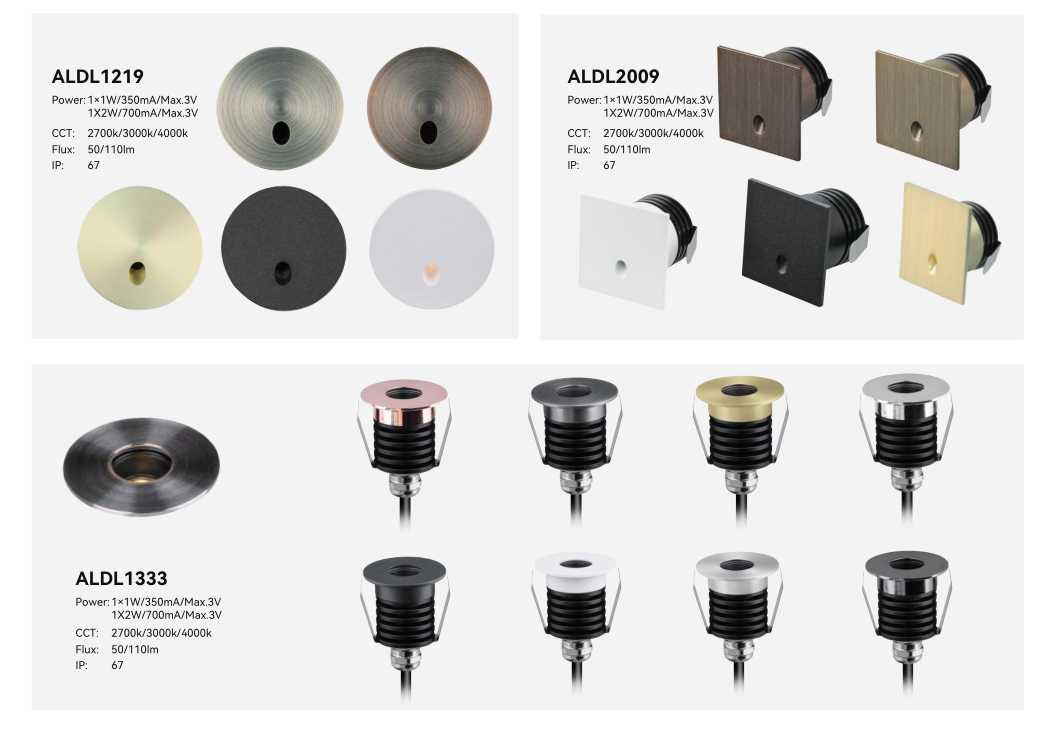
IP65 models such as ALDL1238 (10W, 960lm, cutout ≥75mm) and ALDL1232 (7W, 508lm, Ø60mm cutout) exist for a regulatory reason, not an aesthetic one. The ALDL1409 small recessed light covers the same constraint at Ø22mm with IP65 for compact ceilings.
Commercial and office
Office and retail ceilings prioritise glare control and energy efficiency, typically with UGR below 19 and DALI or sensor control. The ALDL1405 dimmable downlight covers 15–30W and 1300–3200lm over a Ø150mm cutout for larger commercial grids.
Comparing Recessed Downlight Families by Warranty-Relevant Specification
The table below compares ALPHALUCE recessed downlight families on the attributes that most often decide whether a replacement is straightforward: cutout diameter, ingress protection, colour rendering and power.
| Model | Family | Power / Flux | CRI | IP | Cutout | Typical application |
|---|---|---|---|---|---|---|
| ALDL1851 | Recessed Downlights | 7W / 630lm | ≥97 | IP20 | Ø55mm | Hospitality, residential, commercial |
| ALDL1609 | Trimless downlights | 7W / 630lm | ≥92 | IP20 | Ø76–80mm | Residential, hospitality, commercial, office |
| ALDL1587 | Recessed adjustable downlights | 5W / 450lm | ≥92 | IP20 | Ø68–70mm | Hospitality, residential, commercial |
| ALDL1238 | Bathroom recessed light | 10W / 960lm | ≥92 | IP65 | ≥75mm | Bathroom and wet areas |
| ALDL1232 | Waterproof downlights | 7W / 508lm | ≥92 | IP65 | Ø60mm | Bathroom and wet areas |
| ALDL1405 | Dimmable downlights | 15–30W / 1300–3200lm | ≥92 | IP44 | Ø150mm | Hospitality, residential, commercial |
| ALDL1409 | Small recessed lights | 2W / 70lm | ≥90 | IP65 | Ø22mm | Residential, hospitality, bathroom and wet areas |
| ALDL1517 | Square downlights | 7W/10W / 630/960lm | ≥92 | IP54 | 80×80mm | Residential, hospitality, commercial |
| ALDL1590 | Recessed Spotlights | 7W / 585lm | ≥92 | IP20 | Ø35mm | Residential, hospitality, museum |
| ALDL1754 | Directional downlights | 18W / 1800lm | ≥92 | IP20 | Ø90mm | Residential, hospitality, retail display |
Figures as published in ALPHALUCE product specifications. CCT options across these families are 2700K, 3000K and 4000K.
Frequently Asked Questions
What certifications should recessed downlights carry before they are approved for an EU or North American project?
For the EU, the baseline is CE marking supported by RoHS, LVD and EMC conformity; ALPHALUCE products are certified to CE, ETL, RoHS, LVD and EMC standards and supported by ISO-certified quality and environmental management systems. For North America, recessed luminaires must comply with UL 1598 and CSA C22.2 No. 250.0, and fixtures intended for contact with insulation need an “IC” marking under UL 1598 Edition 5. In the UK, BS 7671 requires a minimum IP65 rating in Zone 1 above a bath or shower up to 2.25 m. Request the certificate scope with model numbers listed, because a certificate that does not name the model does not cover it.
Can one supplier cover trimless, adjustable, waterproof and dimmable recessed downlights from a single production base?
Yes, provided the supplier manufactures rather than resells. ALPHALUCE produces across the family range: ALDL1851 at CRI≥97 with a Ø55mm cutout, ALDL1609 trimless at Ø76–80mm, ALDL1587 adjustable at Ø68–70mm, ALDL1238 bathroom at IP65, ALDL1232 waterproof trimless at IP65 with a Ø60mm cutout, and ALDL1405 dimmable at 15–30W with optional DALI or 1–10V control over a Ø150mm cutout. Production runs through the company’s own foundry, surface treatment facilities and assembly plants within a 40,000 m² facility staffed by approximately 150 people, including 20 R&D engineers.
What drives the cost difference between two recessed downlights that look identical on a ceiling?
Four specification items account for most of the gap: colour rendering (CRI ≥92 versus ≥97), ingress protection (IP20 for dry ceilings versus IP65 for wet zones), control gear (fixed output versus DALI or 1–10V dimming), and lumen maintenance (an L70 rating of 50,000 hours versus 30,000 hours). Cutout and tooling add a fifth variable, because a new housing size requires new tooling. Two fixtures that look the same from below can therefore differ substantially in bill of materials.
How should a recessed downlight sample be validated before a full order?
Validate against a fixed checklist rather than a visual impression. Confirm CCT and CRI against the specification — for example CRI≥97 on ALDL1851 versus CRI≥92 on ALDL1609 — check the beam angle set actually ordered from the 15°, 24°, 36° and 55° options, measure the cutout, confirm the IP rating against the room zone, and test the driver on the control protocol that will be installed. Where a trimless format is specified, confirm the plasterboard interface and the trim line before approval, because a trimless ceiling is the most expensive place to correct a mismatch.
How does a long-term supply agreement change lead time and specification consistency?
It changes both, for the same reason: the supplier stops treating each order as a new specification. With in-house casting, surface treatment and assembly, an annual output of approximately 504,000 units and a 20-engineer R&D team handling component changes, a repeat order can be produced against the original specification rather than the current catalogue. That is what protects phased projects. Buyers should confirm in writing how CRI and CCT bins will be matched, how replacement units and spare parts are supplied, and how any specification change is notified before implementation. Samples and project quotations can be requested from ALPHALUCE at info@alphaluce.com or via WhatsApp +86 135 5671 7282.
Conclusion: Buy the Specification, Not the Batch
Recessed downlights are a long-term commitment disguised as a short-term purchase. The ceiling closes once, and every question that follows — warranty scope, replacement matching, certification, availability in year three — is decided by choices made before the first fixture is installed.
The practical rule is straightforward: separate the warranty into housing, driver and lumen maintenance; lock the cutout and trim format before ordering; verify compliance with model-level documentation; and choose a supplier whose production base can reproduce the same specification years later. ALPHALUCE’s combination of an in-house foundry, surface treatment facilities and assembly plants, a 40,000 m² facility, a 20-engineer R&D team and long-term partnerships with more than 300 clients across more than 100 countries is the operational side of that argument.
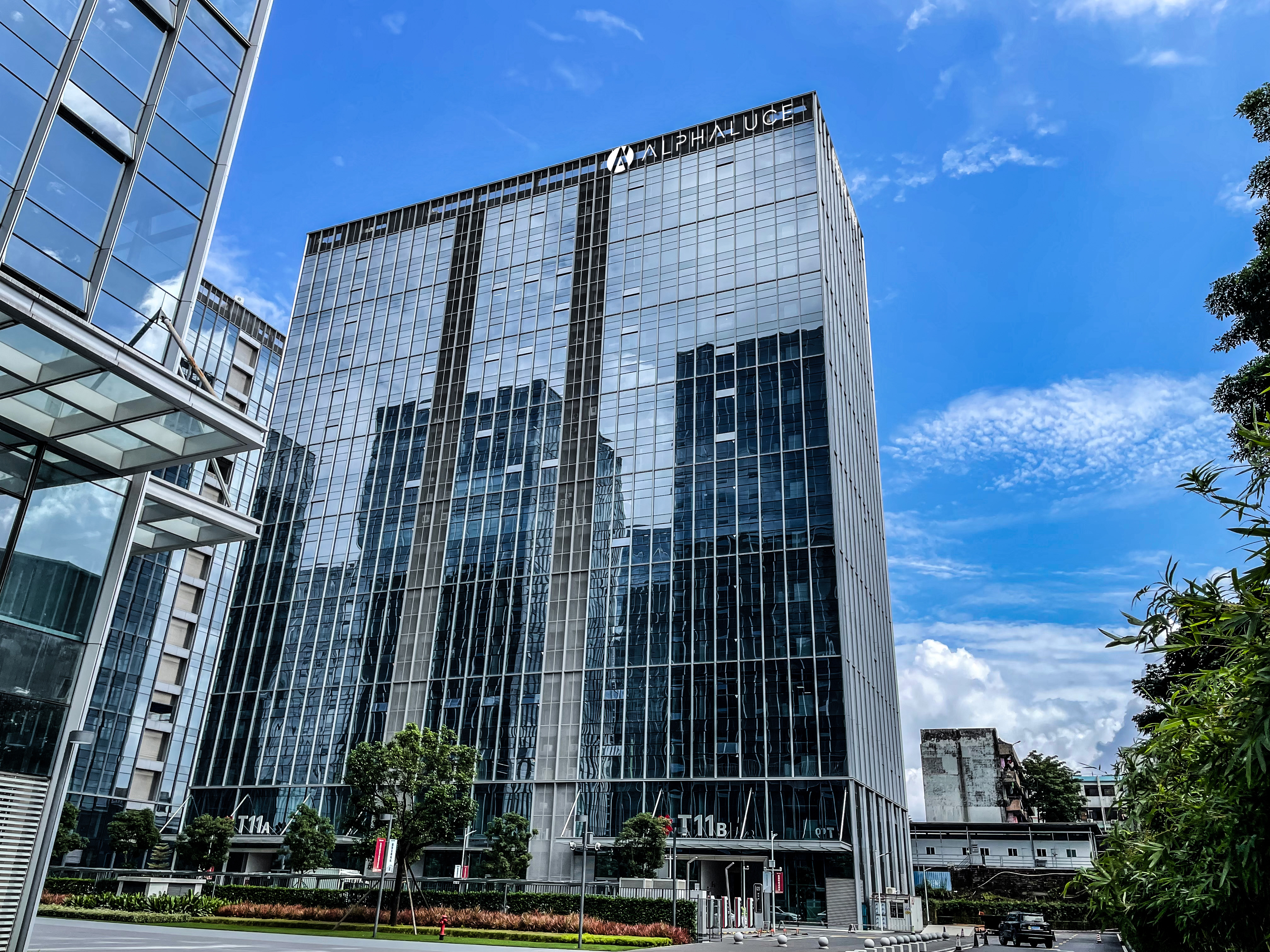
ALPHALUCE ARCHITECTURAL LIGHTING CO., LTD. — design, R&D, manufacturing and sales under one vertically integrated structure.
Meet ALPHALUCE at Hong Kong, October 27–30, 2026
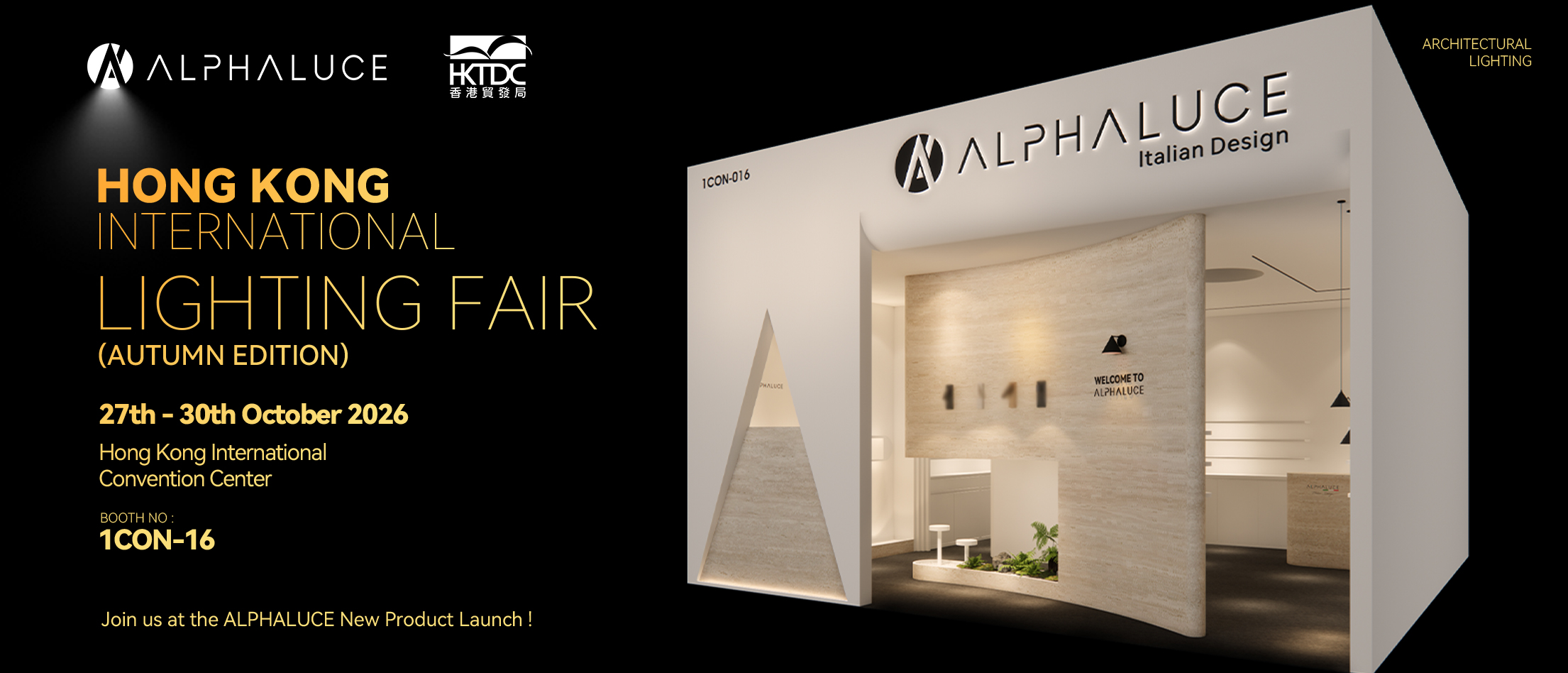
ALPHALUCE will exhibit at the Hong Kong International Lighting Fair (Autumn Edition) 2026 from October 27–30, 2026 at Booth 1CON-16, presenting the 5.8mm Ultra-Slim Smart Magnetic Track System, the GU10 Flexible Downlight Series and the Trimless Grille & Anti-Glare Downlight Series. Visitors can review recessed downlight samples, cutout options and certification documentation in person, and receive a printed catalogue of the full architectural portfolio.
Contact: Danny — Email info@alphaluce.com · WhatsApp +86 135 5671 7282 · www.alphaluce.com
Download the ALPHALUCE product catalogue for full specifications: ALPHALUCE Catalogue (PDF)
Follow ALPHALUCE on Instagram: @alphaluce_lighting
Have Questions or Need More Details?
Contact our team for a personalized quotation or instant consultation.
Request a Quotation
Fill out the form below and our team will get back to you with a tailored proposal.
WhatsApp Direct Chat
Prefer to chat in real-time? Message us on WhatsApp for instant assistance & quick answers.
- Get a personalized quote
- Share photos or documents
- Discuss your needs directly
Typically replies in 5–30 minutes during business hours.