Evaluating an Architectural Lighting Supplier: Beyond Sample Quality
A sample proves what one luminaire can do on the day it was built. It does not prove what the same factory will deliver on unit five hundred, in the third reorder, eight months into a project.
ALPHALUCE is an Italian architectural lighting brand founded in Florence, operating as a vertically integrated manufacturer of recessed downlights, track lighting systems and outdoor landscape fixtures. This article sets out a supplier evaluation framework built on three questions that sample inspection alone cannot answer: how broad the documented product range actually is, how consistent commercial-grade customization remains across repeat orders, and how reliable production and delivery commitments are once a project moves from specification to site.
Problem Definition: Why a Sample Is Not a Supplier Audit
A sample validates one data point. It confirms that a single luminaire can be assembled, finished and photometrically measured to a stated specification. What it does not confirm is that the process which produced it will reproduce the same result at scale, under a different configuration, or after a customization request.
Buyers evaluating architectural lighting solutions run into three specific failure modes when they rely on samples alone.
- Sample-to-production drift. The sample is hand-selected. Production units are drawn from a batch. If the supplier cannot state which inspection regime applies to every unit, the buyer has no basis for knowing whether CRI, lumen output, beam angle or trim finish will hold across the order.
- Customization inconsistency. Commercial projects rarely accept a catalogue default. Once a specification calls for a non-standard CCT, beam angle, surface finish or logo, the evaluation question becomes whether the supplier can repeat that configuration consistently — not whether it can achieve it once.
- Delivery slippage. A sample arrives quickly because it is a priority item. A project order arrives on a schedule defined by site readiness, installation sequencing and opening dates. Lead time and capacity therefore need to be evaluated as engineering constraints, not as polite estimates.
The practical consequence is that the useful question is not “does the sample meet specification?” but “which documented processes made the sample meet specification, and will those same processes apply to the full order?” That reframing turns a visual inspection exercise into a supplier evaluation exercise.
Industry Background: A Larger, More Regulated Specification Environment
Architectural lighting is no longer a niche within general lighting. According to Grand View Research, the global architectural lighting market was valued at USD 11.1 billion in 2025 and is projected to reach USD 17.5 billion by 2033. The same source reports that Asia Pacific accounted for 43.2% of revenue share in 2025, with China as the largest country market, and that the commercial segment represented 50.9% of market share in 2025.
A parallel trend is the shift toward human-centric lighting. Fortune Business Insights valued the human-centric lighting market at USD 3.53 billion in 2024, reflecting demand for lighting that is specified not only for output but for visual comfort, glare control and circadian considerations.
Regulation has tightened alongside the market. Recessed luminaires sold into the European Union must comply with safety standard EN IEC 60598-2-2, published by the International Electrotechnical Commission. In the United Kingdom, BS 7671 wiring regulations require IP44 rated fittings in bathroom Zone 2 and IP65 in Zone 1, directly above a bath or shower, as set out by the Institution of Engineering and Technology.
For a buyer, those two facts change the shape of supplier evaluation. Compliance is not a marketing attribute attached to a brand; it is a document set attached to a product scope. And parameters such as IP rating are not preferences; they are constraints that determine whether a luminaire can legally and safely be installed in a given zone.
It is also worth positioning any supplier against the wider field. Third-party market research lists Acuity Brands, Signify (Philips), Zumtobel Group and ERCO among the major global competitors in architectural lighting. That context matters because it tells a buyer what the benchmark expectations are for documentation, certification and technical support — regardless of which supplier is eventually shortlisted.
Detailed Solution: A Five-Dimension Supplier Evaluation Framework
1. Product range breadth, mapped to actual project layers
Range breadth is only useful if it covers the layers a project actually needs. ALPHALUCE’s product portfolio comprises recessed downlights, track lighting systems, step lights, wall washers, outdoor landscape fixtures and linear lighting solutions, with recessed downlights, track lighting systems and outdoor landscape lights as the main product lines. For a hotel, retail or residential project, that means a single qualification process can cover ceiling, accent, vertical and exterior layers instead of four separate supplier audits.
Breadth also has a practical limit that buyers should test: whether each layer is documented, not merely displayed. A supplier able to state the cutout, IP rating, CRI, beam angles, CCT options and control protocol for each model is a materially different partner from one that can only quote a product name.
2. Commercial-grade customization consistency
This is where most sample-based evaluations break down. ALPHALUCE operates as an OEM/ODM manufacturer with customization available across color, CCT, beam angle, power, surface finish and logo. A minimum order quantity of 100 units applies, and monthly production capacity stands at 42,000 units, with annual output of 504,000 units from a 40,000 m² factory staffed by 150 employees and supported by a 20-engineer R&D team.
The evaluation point is not the capacity figure itself. It is whether customization stays inside a controlled process chain. ALPHALUCE’s vertically integrated structure includes its own foundry, surface treatment facilities and assembly plants, which means the stages most likely to drift during a customized reorder — housing production, finish application and final assembly — are handled in-house rather than through an undisclosed subcontracting chain.
3. Quality systems that sit behind the sample
Ask what happens between assembly and shipment. ALPHALUCE applies a quality control regime of 100% inspection plus aging test, a stronger commitment than sampling-based inspection, because it means every unit is inspected rather than a statistical subset.
That internal control is reinforced by external certification. ALPHALUCE holds ISO 9001:2015 certification (certificate number 04623Q13200R0M), issued by Beijing Head International Certification Co., Ltd. against GB/T 19001-2016 / ISO 9001:2015, covering the production of LED lights.
The product-level certificate set for the European market is specific and verifiable:
- CE-LVD — certificate number 24AS121634S598A002, issued by Guangdong GTG Testing Technology Co., Ltd., covering electrical safety performance testing of recessed LED lighting fixtures against EN 60598-2-2:2012 and EN IEC 60598-1:2021 + AMD11:2022.
- CE-EMC — certificate number 24AE041084E003, issued by Guangdong GTG Testing Technology Co., Ltd., against EN IEC 55015:2019/A11:2020, EN IEC 61547:2023, EN IEC 61000-3-2:2019/A1:2021 and EN 61000-3-3:2013/A2:2021.
- RoHS — certificate number DTI20241484-1DC, issued by Shenzhen Deesev Testing International Corporation (DTI), against the IEC 62321 series for hazardous substance limits in LED lighting products.
- CE-EMC for outdoor luminaires — certificate number 24AE121634E005, issued by Guangdong GTG Testing Technology Co., Ltd., covering electromagnetic compatibility performance for outdoor lighting fixtures.
A buyer evaluating an EU project should ask for the certificate number, the issuing laboratory, the applicable standard and the list of products the certificate covers — and then confirm that the specific models on the bill of quantities appear within that scope.
4. Documentation completeness per model
Parameter-level documentation is what allows a specification to be checked rather than trusted. Representative examples from the ALPHALUCE range include:
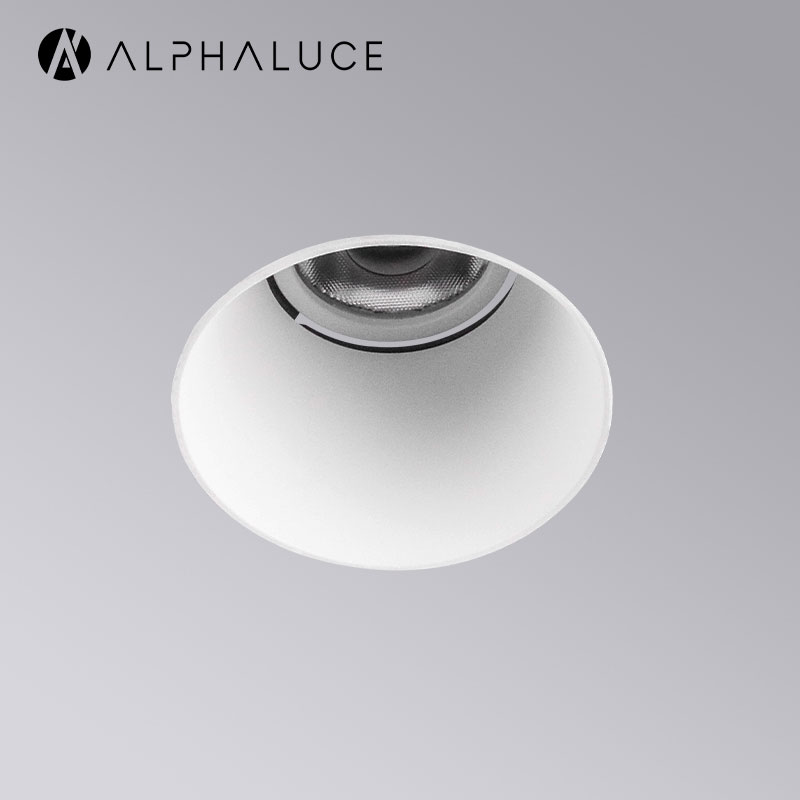
- Recessed downlight ALDL1851: 7W, 630lm, CRI≥97, IP20, beam angles 15°/24°/36°/55°, cutout Ø55mm, CCT 2700/3000/4000K.
- Dimmable downlight ALDL1405: 15–30W, 1300–3200lm, CRI≥92, IP44, 70° beam angle, cutout Ø150mm, optional DALI or 1–10V dimming, CCT 3000/3500/4000K.
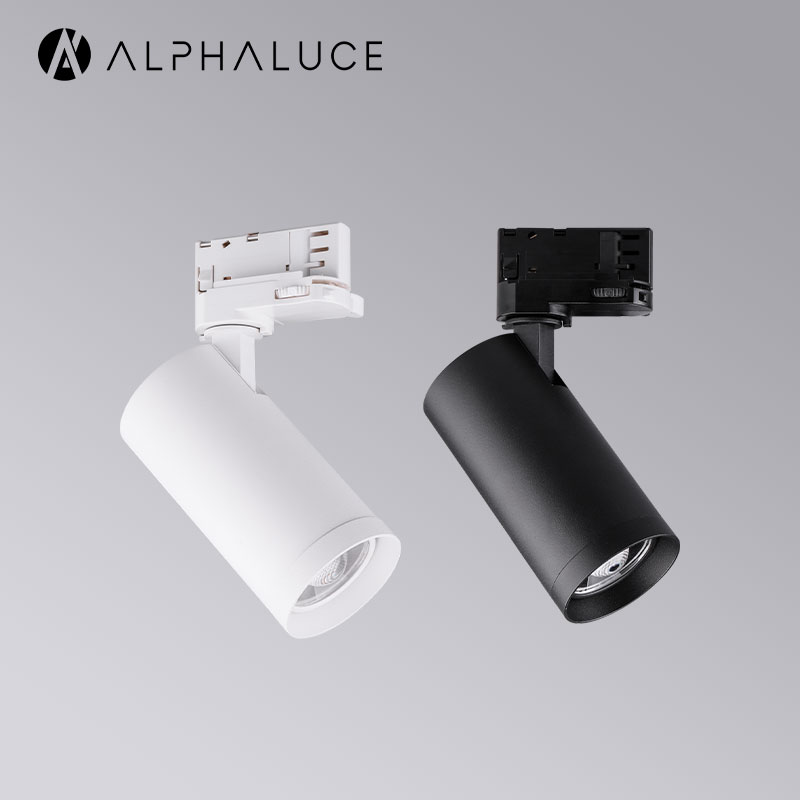
- Track spotlight ALTR0253: 7W, 560lm, CRI≥97, IP20, beam angles 15°/24°/36°/55°, DC48V, 5mm adaptor, adjustable 0–90° tilt and 355° rotation.
- Magnetic track light ALTR0206: 15W, 1180lm, CRI≥90, IP20, beam angles 24°/36°, DC48V, 90° adjustable.
- Garden bollard light ALSL0152: 7W, 422lm, CRI≥90, IP65, DC24V, height options 400/800/1200mm, custom color available.
- Inground light ALDL1677: 5W, 126lm, CRI≥92, IP65, beam angles 15°/24°/36°/60° with 15° adjustment, stainless steel / brush anodized finish.
- Exterior ground lighting ALDL0192: 1W/2W, 60/130lm, CRI≥92, IP67, beam angles 24°/36°, cutout Ø34mm, DC24V.
- Step light ALDL2009: 3W, 270lm, CRI≥92, IP65, cutout 94×35mm, DC24V.
If a supplier cannot produce this level of detail for the exact model being ordered, the sample becomes the only evidence available — which is precisely the position a buyer should avoid.
5. Long-term responsiveness and delivery discipline
Lead time, minimum order quantity and warranty are the three commitments that determine whether a supplier remains usable after the first order. ALPHALUCE states a lead time of 20–30 days, a minimum order quantity of 100 units and a 5-year warranty. The company exports approximately 80% of its output to Europe, the Middle East, North America and Australia, and reports long-term partnerships with more than 300 clients across more than 100 countries and regions.
Commercial hospitality and office projects in the case record include hotel installations in Korea, China, Sri Lanka, Laos, Mauritius, Fiji, Mexico, Thailand, Austria and Singapore, plus commercial projects in China, the United Arab Emirates and Belgium, each recorded at 200–500 units with a stated duration of L90B10 > 50,000 hours. For a buyer, the relevant signal is repeat deployment across regions and building types, not a single flagship reference.
Step-by-Step Breakdown: How to Run the Evaluation
The sequence below is designed to be run before a purchase order is issued, and to produce a decision record that can be revisited if problems appear during installation.
Step 1 — Define the luminaire layers the project actually needs
List every layer: recessed ceiling downlights, adjustable accent luminaires, track-mounted spotlights, wall-mounted fittings, step and stair lights, and exterior bollards, spike lights or inground fixtures. A supplier should be evaluated against the full list, not against the single model that was sampled.
Step 2 — Request the datasheet and certificate set before the sample
Ask for the parameter sheet for each model on the list, plus the certificate set relevant to the destination market. For EU projects this means CE-LVD, CE-EMC and RoHS documentation, each with a certificate number and an issuing laboratory.
Step 3 — Audit the certificate scope, not the certificate name
A CE certificate covering recessed luminaires does not automatically cover a track-mounted fitting or an outdoor bollard. The outdoor CE-EMC certificate 24AE121634E005 and the CE-LVD certificate 24AS121634S598A002 cover defined product scopes; confirm that your bill of quantities sits inside them.
Step 4 — Test customization on a second, different model
Customization capability stated once is easy. Customization capability repeated across two different product platforms is evidence. Request the same non-standard treatment — for example a surface finish change or a specific CCT — on two models from different families, such as a recessed downlight and a track spotlight, and compare the delivered result.
Step 5 — Ask for production control evidence
Request a written statement of the inspection regime. A regime of 100% inspection plus aging test means every unit is inspected and aged, which is materially different from batch sampling. Where available, ISO 9001:2015 certification provides the framework in which that regime sits.
Step 6 — Qualify lead time and capacity against your order profile
Compare your required volume and delivery date against stated lead time and capacity. ALPHALUCE states a 20–30 day lead time, a monthly capacity of 42,000 units and a minimum order quantity of 100 units. If your order includes customized finishes or non-standard CCTs, ask explicitly whether those configurations change the schedule.
Step 7 — Lock warranty and after-sales into the contract
Warranty terms should be written into the order confirmation rather than assumed. ALPHALUCE offers a 5-year warranty. Confirm what the warranty covers, which party handles replacement logistics in your market, and what documentation is required to raise a claim.
Use Cases: Where the Framework Changes Shape
Hospitality and hotel projects
Hotel lighting runs continuously, often with 24/7 operation, across lobby, corridor, restaurant, guest room and outdoor areas within the same building. Documented requirements for this sector include high CRI (≥92), anti-glare optics, warm CCT in the 2700K–3000K range and IP65 for outdoor zones, typically with DALI or KNX dimming systems. Evaluation focus: CCT consistency across hundreds of identical units, and dimming compatibility at system level.
Office and commercial interiors
Commercial interiors prioritize glare control and visual comfort, with documented requirements including high CRI (≥90), UGR<19 glare control, flicker-free operation and optional tunable white. Evaluation focus: whether the supplier can evidence glare control and flicker performance for the specified models rather than for the product family in general.
Retail display and museum lighting
Retail and museum projects rely on precise beam control. Documented requirements for museum environments include CRI≥95, no UV/IR emission, glare-free optics and precise beam control, usually delivered through track systems. The ALPHALUCE track spotlight ALTR0253 offers CRI≥97 with 15°/24°/36°/55° beam angles and 355° rotation, while the commercial track light ALTR0247 provides a 15–60° beam adjustment range. Evaluation focus: aiming repeatability and adaptor standardization across units.
Outdoor landscape and garden projects
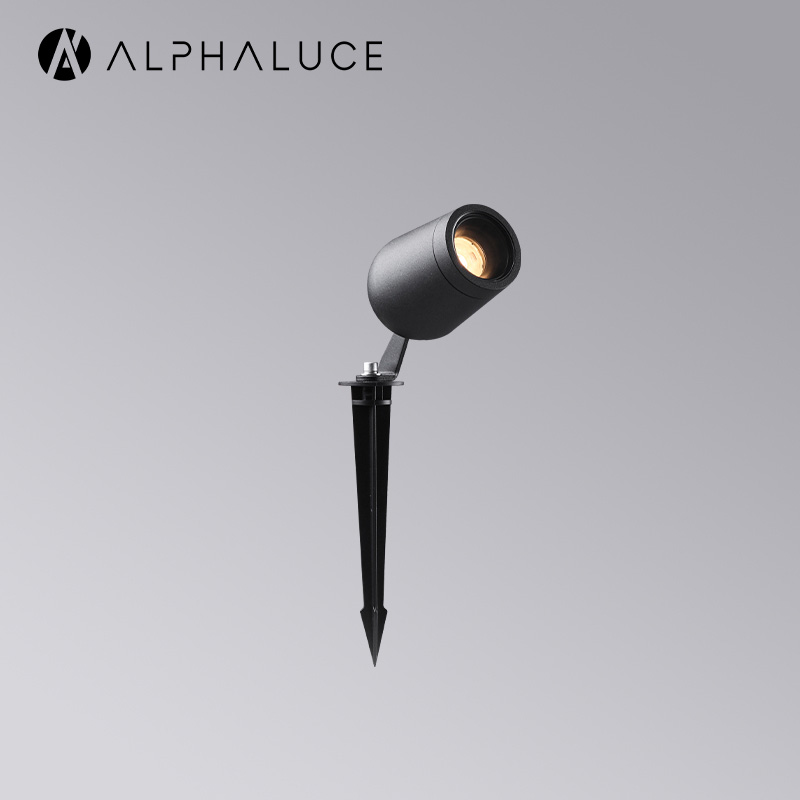
Exterior installations operate outdoors at night and are specified for accent and safety lighting, with documented requirements including IP67, corrosion resistance, UV protection and CRI≥90, supported by timers, photocell sensors and low-voltage transformers. Products such as the exterior ground lighting ALDL0192 (IP67, Ø34mm cutout) and the inground light ALDL1677 (IP65, stainless steel or brush anodized finish) illustrate why finish and ingress protection must be evaluated as documented parameters rather than visual qualities.
Bathroom and wet areas
Wet-area lighting is a compliance question before it is a design question. UK BS 7671 requires IP44 in Zone 2 and IP65 in Zone 1 above a bath or shower. The bathroom recessed light ALDL1238 is rated IP65 with 10W, 960lm, CRI≥92 and a cutout of ≥75mm, and the waterproof downlight ALDL1232 is IP65 with a trimless design. Evaluation focus: confirming that the specified IP rating is documented for the exact model and is supported by the appropriate test evidence.
Comparison Table: What to Verify by Product Family
The table below maps representative ALPHALUCE product families to their documented parameters and the evaluation point that matters most for each family.
| Product family | Representative model | Documented parameters | Typical application | Primary evaluation focus |
|---|---|---|---|---|
| Recessed downlight | ALDL1851 | 7W, 630lm, CRI≥97, IP20, 15°/24°/36°/55°, cutout Ø55mm, CCT 2700/3000/4000K | Hospitality, residential, commercial | CRI and cutout consistency across batches |
| Recessed adjustable downlight | ALDL1587 | 5W, 450lm, CRI≥92, IP20, 15°/24°/36°/55°, cutout Ø68–70mm | Hospitality, residential, commercial | Aiming range and trim finish repeatability |
| Bathroom recessed light | ALDL1238 | 10W, 960lm, CRI≥92, IP65, cutout ≥75mm | Bathroom and wet areas | IP rating matched to BS 7671 zones |
| Dimmable downlight | ALDL1405 | 15–30W, 1300–3200lm, CRI≥92, IP44, 70°, cutout Ø150mm, optional DALI or 1–10V dimming | Hospitality, commercial | Driver and dimming compatibility at system level |
| Track spotlight | ALTR0253 | 7W, 560lm, CRI≥97, IP20, DC48V, 5mm adaptor, 0–90° tilt, 355° rotation | Retail display, museum | Adaptor standard and aiming repeatability |
| Commercial track light | ALTR0247 | 8W, 680lm, CRI≥92, IP20, 15–60°, 0–90° tilt, 350° rotation | Retail display, museum | Beam adjustment consistency between units |
| Garden bollard light | ALSL0152 | 7W, 422lm, CRI≥90, IP65, DC24V, height 400/800/1200mm, custom color available | Landscape | Finish durability and height configuration |
| Spike light | ALSL0086 | 7W, 560lm, CRI≥97, IP65, 12°/24°/38°/50°, DC24V, 0–45° tilt | Landscape | Glare control and field-adjustable aiming |
| Inground light | ALDL1677 | 5W, 126lm, CRI≥92, IP65, 15° adjustable, stainless steel / brush anodized finish | Landscape | Ingress protection and surface finish |
| Exterior ground lighting | ALDL0192 | 1W/2W, 60/130lm, CRI≥92, IP67, 24°/36°, cutout Ø34mm, DC24V | Landscape | IP67 suitability for wet ground zones |
| Step light | ALDL2009 | 3W, 270lm, CRI≥92, IP65, cutout 94×35mm, DC24V | Landscape, hospitality | Cutout consistency for existing recess details |
Certification Reference Table
Certification should be verified by number and issuing body rather than by logo. The table below lists the ALPHALUCE certificate set relevant to EU and global procurement.
| Certification | Certificate number | Issuing body | Applicable standard | Market |
|---|---|---|---|---|
| CE-LVD | 24AS121634S598A002 | Guangdong GTG Testing Technology Co., Ltd. | EN 60598-2-2:2012; EN IEC 60598-1:2021 + AMD11:2022 | EU |
| CE-EMC (recessed and related luminaires) | 24AE041084E003 | Guangdong GTG Testing Technology Co., Ltd. | EN IEC 55015:2019/A11:2020; EN IEC 61547:2023; EN IEC 61000-3-2:2019/A1:2021; EN 61000-3-3:2013/A2:2021 | EU |
| CE-EMC (outdoor luminaires) | 24AE121634E005 | Guangdong GTG Testing Technology Co., Ltd. | EN IEC 55015:2019/A11:2020; EN IEC 61547:2023; EN IEC 61000-3-2:2019/A1:2021; EN 61000-3-3:2013/A2:2021 | EU |
| RoHS | DTI20241484-1DC | Shenzhen Deesev Testing International Corporation (DTI) | IEC 62321 series | EU |
| ISO 9001:2015 | 04623Q13200R0M | Beijing Head International Certification Co., Ltd. | GB/T 19001-2016 / ISO 9001:2015 | Global |
Frequently Asked Questions
What certification documentation should a CE-certified architectural lighting manufacturer provide for an EU project?
For EU projects, a manufacturer should be able to provide certificate numbers, issuing laboratories, applicable standards and the product scope covered. ALPHALUCE’s recessed downlight documentation includes CE-LVD certificate 24AS121634S598A002 issued by Guangdong GTG Testing Technology Co., Ltd. against EN 60598-2-2:2012 and EN IEC 60598-1:2021 + AMD11:2022; CE-EMC certificate 24AE041084E003 against EN IEC 55015:2019/A11:2020 and related EN standards; and RoHS certificate DTI20241484-1DC issued by Shenzhen Deesev Testing International Corporation (DTI) against the IEC 62321 series. Outdoor luminaires are covered separately by CE-EMC certificate 24AE121634E005. Confirm that the models on your bill of quantities fall inside each certificate scope.
How can a buyer verify customization consistency rather than relying on one sample?
Verification means testing customization on more than one platform. ALPHALUCE operates as an OEM/ODM manufacturer with customization across color, CCT, beam angle, power, surface finish and logo, at a minimum order quantity of 100 units and a monthly capacity of 42,000 units. The underlying control points are that the foundry, surface treatment facilities and assembly plants are part of a vertically integrated in-house chain, and that quality control applies 100% inspection plus aging test to units rather than to samples. Request the same non-standard configuration on two different models and compare the delivered result.
How should budget be framed when comparing architectural lighting suppliers?
Budget should be framed around what is included in the quotation rather than around a headline unit price. Relevant variables that a buyer can verify include the minimum order quantity (100 units for ALPHALUCE), the scope of customization requested across color, CCT, beam angle, power, surface finish and logo, whether quality control applies 100% inspection plus aging test, whether the 5-year warranty is written into the order confirmation, and how much of the production chain is in-house. ALPHALUCE does not publish price bands, so comparisons are best made on like-for-like specification, documentation and service scope.
What should a pre-production sample actually prove?
A pre-production sample should prove the exact parameters that will be repeated in production, not general build quality. Useful checks include photometric and physical values such as 7W, 630lm, CRI≥97 and a Ø55mm cutout on the recessed downlight ALDL1851; DALI or 1–10V dimming options on the dimmable downlight ALDL1405; and DC48V operation with a 5mm adaptor, 0–90° tilt and 355° rotation on the track spotlight ALTR0253. The sample is only meaningful if the supplier confirms the same parameter set applies to the production order and that every unit is inspected and aged before shipment.
What lead time and delivery commitments are reasonable to expect?
ALPHALUCE states a lead time of 20–30 days, a minimum order quantity of 100 units, a monthly production capacity of 42,000 units and a 5-year warranty, with approximately 80% of output exported to Europe, the Middle East, North America and Australia. Buyers should confirm in writing whether customized finishes, non-standard CCTs or beam configurations alter that schedule, and should request the datasheet set, certificate documentation and a quotation before committing to a project programme. Datasheets, samples and quotations can be requested from ALPHALUCE at info@alphaluce.com or via WhatsApp on +86 135 5671 7282.
Conclusion: Evaluate the Process, Not the Sample
A sample is evidence of capability at a single point in time. A supplier evaluation should establish something different: that the parameters on the specification sheet are documented, that the certificate set covers the exact models being ordered, that customization can be repeated across more than one product platform, that every unit is inspected and aged rather than sampled, and that lead time, minimum order quantity and warranty are commitments rather than assumptions.
For architectural lighting solutions spanning recessed downlights, track lighting systems and outdoor landscape fixtures, that framework produces a decision record a project team can defend — to a client, to a consultant, or to a warranty claim two years after handover.
About ALPHALUCE
ALPHALUCE ARCHITECTURAL LIGHTING CO. is an Italian architectural lighting brand founded in Florence and operating as a vertically integrated manufacturer, founded in 2010, based in Dongguan, Guangdong, China. The company runs a 40,000 m² factory with 150 employees, annual output of 504,000 units, a 20-engineer R&D team, and approximately 80% export share across Europe, the Middle East, North America and Australia. ALPHALUCE reports long-term partnerships with more than 300 clients in more than 100 countries and regions, and provides one-stop integrated lighting solutions for commercial and residential spaces including luxury hotels, high-end residences, commercial offices, retail displays and restaurants.
Product information: alphaluce.com · Technical articles: news.alphaluce.com
Request the datasheet set, a sample or a project quotation
Send your luminaire schedule and destination market, and ALPHALUCE will return the matching datasheets, certificate documentation and lead-time confirmation.
Contact: Danny · Email: info@alphaluce.com · WhatsApp / Tel: +86 135 5671 7282
Download the ALPHALUCE product brochure: ALPHALUCE catalogue (PDF)

Have Questions or Need More Details?
Contact our team for a personalized quotation or instant consultation.
Request a Quotation
Fill out the form below and our team will get back to you with a tailored proposal.
WhatsApp Direct Chat
Prefer to chat in real-time? Message us on WhatsApp for instant assistance & quick answers.
- Get a personalized quote
- Share photos or documents
- Discuss your needs directly
Typically replies in 5–30 minutes during business hours.