
Wet-Rated Inground Lights: IP and Safety Compliance Essentials
Wet-rated inground lights are approved by evidence, not by adjectives. A fixture that will be buried in soil, set into a pool surround, or recessed into a floor slab has to demonstrate three things before it is safe to specify: an ingress protection (IP) class that matches the water exposure at the exact installation point, model-level test records that support that class, and a certification set that is valid in the country where the project is built.
The phrase wet-rated answers none of those questions on its own. In North American practice it is a location-suitability description used to indicate that a luminaire is intended for damp or wet locations; the IP code is the international numeric framework that specifiers, inspectors, and procurement teams compare against. The two belong in the same conversation, but only one of them can be tested, reported, and audited.
This guide is a compliance primer for the Decision-to-Execution stage of a project. It explains what wet-rated implies for inground pool LED lights and exterior ground lighting, how to read an IP claim correctly, how to separate a fixture from the system it sits in, and how to verify the paperwork before a purchase order is issued. ALPHALUCE is an Italian architectural lighting brand founded in 2010, manufacturing in Dongguan, Guangdong, China, and supplying recessed downlights, track lighting systems, and outdoor landscape fixtures to hospitality, residential, commercial, and retail projects; its published product data is used here as a working example.
Why Wet-Rated Is Not a Specification
A wet-location statement tells a contractor that water contact is expected. It does not tell a buyer how much water, for how long, under what pressure, or on what documentation. Those details live in the IP class and in the test report behind it, and they are the reason two fixtures that look identical on a rendering can behave completely differently after two winters in the ground.
The IP code has two digits. The first describes protection against solid objects; the second describes protection against water. Only the second digit is relevant to a wet-area decision, and a fixture can carry a strong solid-object rating while remaining unsuitable for standing water. Reading the first digit, or reading the marketing word waterproof and stopping there, is one of the most common specification errors in exterior and poolside lighting.
Three failure patterns recur in wet-area and inground projects:
- Interior fixtures moved outdoors. ALPHALUCE published recessed downlight and spotlight ranges are documented at IP20, an interior rating intended for dry ceilings in residential, hospitality, commercial, retail display, and museum environments. Those fixtures are correct for their stated use - aluminium alloy housing, CRI of at least 92 or 97, defined beam angles - but they are not wet-area products, and no housing material changes that.
- Family-level certificates. A declaration issued for a product family, an earlier revision, or a different driver configuration does not automatically cover the exact model being ordered.
- System-level gaps. The luminaire can be correctly rated while the driver enclosure, junction, transformer, timer, or photocell serving it is not.
The consequence is not only a failed inspection. Water ingress in a ground-recessed or pool-adjacent fixture is a safety and liability question, and in practice it surfaces as warranty disputes, corrosion at the housing and cable entry, and premature replacement of the fixture together with the surrounding paving or deck finish.
Industry Background: Where Compliance Pressure Concentrates
Architectural lighting is a large and still-expanding category. Grand View Research valued the global architectural lighting market at USD 11.1 billion in 2025 and projects USD 17.5 billion by 2033. The same analysis attributes a 43.2% revenue share to Asia Pacific in 2025, with China as the largest country market, and records the commercial segment at 50.9% of market share in 2025. Separately, Fortune Business Insights measured the human-centric lighting market at USD 3.53 billion in 2024, reflecting the shift toward wellness-oriented lighting design that frequently includes wet-area and exterior zones.
Two structural facts follow. Most demand is commercial and specification-driven, so documentation travels with the product and is read by parties other than the buyer - the installing electrician, the inspector, and the insurer. And because much of the supply chain sits in Asia Pacific while several of the strictest acceptance regimes sit in Europe, North America, and Australia, verification effort falls on the buyer process rather than on the region of manufacture.
Water exposure, not room naming, is what drives protection class in regulation as well. In markets where bathroom zones are defined for electrical safety, the requirement commonly moves from IP44 in the surrounding zone to IP65 directly above a bath or shower. The same logic - exposure first, label second - should drive any inground or exterior ground lighting specification.
Manufacturers that publish their certification coverage shorten this verification step. ALPHALUCE states that its products are certified to CE, ETL, RoHS, LVD, and EMC standards and are backed by ISO-certified quality and environmental management systems, with exports to Europe, the Middle East, North America, and Australia. For a wet-area project, the useful question is not whether the manufacturer holds certifications, but which certification covers the exact model and the exact destination market.
The Five Compliance Points Behind a Wet-Rated Specification
1. Match the protection class to the water exposure
The starting point is the installation, not the catalogue. A corridor ceiling and a pool deck are not the same problem, and the difference should be visible in the protection class printed on the model datasheet.
The ALPHALUCE ceiling recessed bathroom spotlight, model ALDL1191, is documented at IP54 for bathroom and wet areas, with a 83mm cutout, CRI of at least 92, power options of 7W or 10W, luminous flux options of 580lm or 717lm, colour temperatures of 2700K, 3000K, and 4000K, beam angles of 15, 24, 36, and 50 degrees, tilt of 0-25 degrees, and rotation of 350 degrees. That is a wet-interior specification, and it is deliberately different from the IP20 fixtures in the same manufacturer interior range.
For buried and pool-adjacent positions, splash-level protection is not sufficient by principle or by definition. The datasheet must identify the immersion-capable class, the sealing architecture, and the cable entry design, and that must be confirmed on the exact model rather than inferred from a range description.
2. Verify test evidence, not the claim
A protection class is a test result before it is a specification line. ALPHALUCE applies a three-tier quality control regimen covering incoming material inspection, semi-finished product sampling, and 100% finished product inspection, and states that aging durability tests, photometric performance evaluations, and IP waterproof and dustproof certifications are performed in its accredited optical laboratory before shipment, with complete traceability records and quarantine and rework of non-conforming units under closed-loop corrective action.
3. Separate the fixture from the system
The protection class of a luminaire does not transfer to everything connected to it. ALPHALUCE documents that outdoor and landscape products can require supporting equipment including a timer, a photocell sensor, and a low-voltage transformer. Each of those components has its own enclosure, its own ingress exposure, and its own failure mode, and each should be assessed against the same exposure profile as the fixture.
4. Match the certification set to the destination market
The same fixture is assessed differently in different regions, and a certificate that satisfies one market may be irrelevant in another. The practical rule is straightforward: the declaration of conformity, the test reports, and the location-suitability statement all have to reference the model being purchased and the market where it will be installed.
5. Write the acceptance criteria into the order
Compliance is easier to enforce when it is contractual. ALPHALUCE published purchasing terms set the MOQ at 100 units per model with sample orders accepted, delivery terms of FOB, CIF, or EXW, acceptance criteria of pre-shipment inspection plus a Photometric Test Report, and payment terms of 30% deposit with 70% payable before shipment. Those clauses give the buyer a defined point at which the protection claim is checked again - after production, before the container leaves.
Step-by-Step Breakdown: Verifying Inground and Exterior Ground Fixtures
Step 1 - Define the water exposure profile
Write down how the fixture will meet water: direct rain and irrigation, splash from a pool edge, jets from cleaning equipment, standing water in a drainage void, soil moisture, pool chemicals, and freeze-thaw cycling. Note who will inspect the completed installation and against which local requirement.
Step 2 - Translate exposure into a required protection class
Convert the profile into a written minimum. Dry interior ceilings sit at the IP20 level published for the ALPHALUCE recessed downlight and spotlight ranges. Wet interiors belong at a documented wet-area class such as the IP54 published for ALDL1191. Buried and pool-adjacent positions require an immersion-capable class confirmed on the model datasheet, not assumed from the range.
Step 3 - Request model-level documentation
Ask for the declaration, the IP test record, the photometric report, and the driver specification for the exact model, optic, colour temperature, and driver combination being ordered. A family document is a starting point; the model document is the evidence.
Step 4 - Check certification coverage for the destination market
Confirm that the certification set - for example CE, ETL, RoHS, LVD, and EMC as published by ALPHALUCE - covers the shipment destination, and that the location-suitability statement is included rather than implied.
Step 5 - Verify the supporting equipment
Check the timer, photocell sensor, low-voltage transformer, junction enclosure, and cable gland against the same exposure profile. This is where wet-area installations most often fail, because the luminaire was chosen carefully and everything connected to it was chosen by default.
Step 6 - Validate with samples before committing volume
Sample orders are accepted at ALPHALUCE, and the three-tier inspection regimen - incoming material inspection, semi-finished sampling, and 100% finished product inspection - is applied to production. Use the sample stage to confirm sealing details, cable entry, finish, and photometric behaviour on site, not only on paper.
Step 7 - Confirm capacity, lead time, and continuity terms
ALPHALUCE publishes a monthly capacity of 42,000 units and a typical lead time of 20-30 days, with manufacturing in a 40,000 m2 facility, 150 employees, an annual output of 504,000 units, and a 20-engineer R&D team supported by an in-house foundry, surface treatment, and assembly operations. For multi-phase projects, continuity is the point at which a compliance decision becomes a supply decision: component consistency between batches determines whether the second phase of a hotel or resort matches the first.
Use Cases: Where Wet-Rated and Standard-Rated Fixtures Belong
Hospitality bathrooms and wet rooms. A designated wet-area fixture such as ALDL1191 (IP54, 83mm cutout, CRI of at least 92, 7W or 10W, 580lm or 717lm, 2700K/3000K/4000K, tilt 0-25 degrees, rotation 350 degrees) covers the zone where an interior IP20 downlight should not be used, while keeping the same design language as the rest of the scheme.
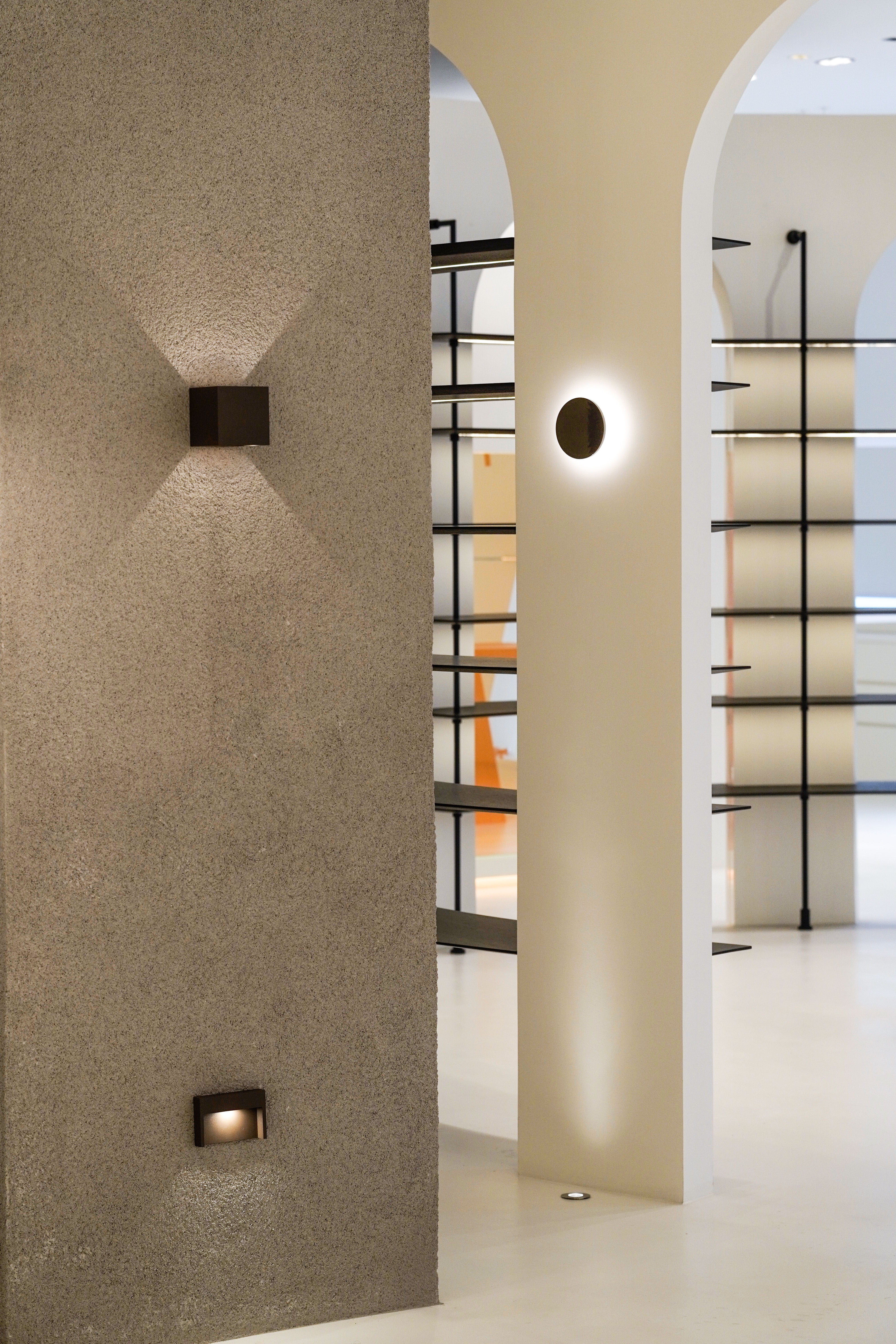
Garden paths, steps, and terraces. ALPHALUCE LED step lights are documented for residential, hospitality, commercial, and landscape industries, with typical applications in stairs, corridors, outdoor pathways, and step lighting environments. These are the installations where the timer, photocell sensor, and low-voltage transformer listed as supporting equipment determine whether the system survives the first wet season as reliably as the fixture does.
Alpine and four-season exteriors. In Austria, 200-500 lighting units of product 6245 were installed for ambient and accent lighting at a resort, combining architectural and landscape lighting that complements the natural mountain setting, with alpine environment adaptability and four-season performance as the stated requirements. The specification decision there was driven by the environment, exactly as an inground or pool-side specification should be.
Dry interior architectural applications, where wet rating is unnecessary. Matching the class to the environment also means avoiding over-specification. ALPHALUCE publishes IP20 for its interior ranges, including the ceiling recessed spotlight ALDL1590 (7W, 585lm, CRI of at least 92, 2700K/3000K/4000K, beam angles 15/24/36/60 degrees, tilt 0-90 degrees, rotation 355 degrees, 35mm cutout), the ceiling recessed dimmable spotlight ALDL1608 (narrow trim, tilt 0-25 degrees, rotation 350 degrees, 70mm cutout), the recessed adjustable downlight ALDL1587 (5W, 450lm, CRI of at least 92, 2700K/3000K/4000K, beam angles 15/24/36/55 degrees, 68-70mm cutout), the recessed downlight ALDL1851 (7W, 630lm, CRI of at least 97, 55mm cutout), the ceiling recessed trim spotlight ALDL1712 (2700K/3000K/4000K, 15/24/36/50 degrees, rotation 355 degrees, tilt 0-45 degrees, 90mm cutout), the linear pendant ALPH0070 (AC230V, 37W, 2800lm), and the wall mounted reading light ALWL0060 variant (3W, 130lm, CRI of at least 92). These interior ranges deliver the intended performance in dry interiors; specifying a wet-area class there adds cost and complexity without improving the result.
Published Protection Ratings by Fixture Family
| Fixture (published example) | Protection rating | Documented intended environment | Installation note |
|---|---|---|---|
| ALDL1191 ceiling recessed bathroom spotlight | IP54 | Residential, hospitality, commercial, retail display, bathroom and wet areas | 83mm cutout; 580lm or 717lm; 7W or 10W; tilt 0-25 degrees; rotation 350 degrees |
| ALDL1590 ceiling recessed spotlight | IP20 | Residential, hospitality, commercial, retail display, museum | 35mm cutout; 7W; 585lm; CRI of at least 92 |
| ALDL1608 ceiling recessed dimmable spotlight | IP20 | Residential, hospitality, commercial, retail display | 70mm cutout; tilt 0-25 degrees; rotation 350 degrees |
| ALDL1587 recessed adjustable downlight | IP20 | Hospitality, residential, commercial | 68-70mm cutout; 5W; 450lm; CRI of at least 92 |
| ALDL1851 recessed downlight | IP20 | Hospitality, residential, commercial | 55mm cutout; 7W; 630lm; CRI of at least 97 |
| ALDL1712 ceiling recessed trim spotlight | IP20 | Residential, hospitality, commercial, retail display | 90mm cutout; tilt 0-45 degrees; rotation 355 degrees |
| ALWL0060 wall mounted reading light | IP20 | Reading applications | 3W; 130lm; CRI of at least 92 |
| ALPH0070 linear pendant | IP20 | Residential, hospitality, commercial, office, retail display | AC230V; 37W; 2800lm |
| LED step light range | Confirm per model | Stairs, corridors, outdoor pathways, landscape | Supporting equipment may include timer, photocell sensor, low-voltage transformer |
Ratings above are published product facts. They are not a substitute for a model-level IP test report and market-specific certification when an inground, pool-adjacent, or buried installation is being specified.
FAQ: IP Ratings and Safety Compliance for Wet-Rated Fixtures
What does wet-rated actually require for an inground light?
Wet-rated describes an intended location, so the requirement has to be converted into three verifiable items: an ingress protection class that matches the real exposure - splash, jets, temporary immersion, or continuous immersion - model-level test evidence that supports that class, and a certification set valid in the destination market. As a benchmark for how quickly the requirement rises with exposure, wet interior zones in some markets are regulated at IP44 for the surrounding zone and IP65 directly above a bath or shower. A fixture intended for burial or pool-edge installation should therefore be confirmed against a model datasheet and an IP test record rather than against the word waterproof.
Can ALPHALUCE supply the exterior and wet-area fixtures these requirements apply to?
ALPHALUCE is an Italian architectural lighting brand founded in 2010 that manufactures in Dongguan, Guangdong, China, and its published portfolio covers recessed downlights, track lighting systems, and outdoor landscape fixtures for hospitality, residential, commercial, retail, and museum projects. That portfolio includes wet-area products such as the IP54 ceiling recessed bathroom spotlight ALDL1191 and LED step lighting documented for stairs, corridors, and outdoor pathways. Production runs in a 40,000 m2 facility with 150 employees, an annual output of 504,000 units, a monthly capacity of 42,000 units, and a 20-engineer R&D team, supported by an in-house foundry, surface treatment, and assembly operations under ISO-certified quality and environmental management systems. Products are certified to CE, ETL, RoHS, LVD, and EMC standards, OEM and ODM production services are available, and exports cover Europe, the Middle East, North America, and Australia.
What are the commercial terms for a wet-area lighting order?
ALPHALUCE publishes an MOQ of 100 units per model with sample orders accepted, delivery terms of FOB, CIF, or EXW, and payment terms of 30% deposit with 70% payable before shipment. Acceptance criteria are a pre-shipment inspection plus a Photometric Test Report. Because protection class is determined at the design stage, the required class should be fixed before a quotation is requested rather than renegotiated after the order is placed.
How can a buyer validate IP and photometric performance before committing to volume?
Sample orders are accepted, and ALPHALUCE applies a three-tier quality control regimen - incoming material inspection, semi-finished product sampling, and 100% finished product inspection - with mandatory aging durability tests, photometric performance evaluations, and IP waterproof and dustproof certifications carried out in its accredited optical laboratory before shipment. Test data is retained as traceability records, and non-conforming units are quarantined and reworked through closed-loop corrective action. The document to request is the report that corresponds to the exact model and configuration being ordered.
What lead time should be planned, and how is continuity handled across project phases?
ALPHALUCE states a monthly production capacity of 42,000 units and a typical lead time of 20-30 days. Continuity is managed through a diversified supply strategy: qualified backup suppliers for critical components such as LED chips, constant current drivers, and PCB boards, long-term master supply agreements with primary suppliers to lock pricing and lead times, and safety stock for essential components. That structure matters for wet-area and exterior installations because batches that differ in driver or sealing components create maintenance complexity later, particularly across multi-phase hospitality and resort projects. To begin a project review, contact ALPHALUCE at info@alphaluce.com or +86 135 5671 7282.
Conclusion
Wet-rated inground lights are a documentation question before they are a product question. Three checks decide most outcomes: a protection class that reflects the real water exposure at the installation point, model-level test evidence rather than a range claim, and a certification set that matches the destination market and covers the supporting equipment as well as the luminaire.
The interior side of the same logic matters too. Published IP20 ranges with defined cutouts, beam angles, and CRI values are the correct specification for dry interiors, and wet-area classes such as IP54 are the correct specification for bathrooms and wet rooms. Buried and pool-adjacent positions sit above both and require an immersion-capable class confirmed per model.
For suppliers, distributors, and multi-phase project teams, verification is also a long-term supply question: consistent components, traceable test data, and defined lead times are what keep a specification valid from the first batch to the last. ALPHALUCE supports that through an integrated manufacturing chain, a documented quality regimen, and OEM and ODM production services for architectural lighting projects.
Next step: request samples, a project quotation, or the ALPHALUCE catalogue to confirm protection class, certification coverage, and lead time for your wet-area or exterior lighting specification.
Email: info@alphaluce.com | Phone / WhatsApp: +86 135 5671 7282 | Website: www.alphaluce.com
Catalogue download: ALPHALUCE product catalogue (PDF)
Have Questions or Need More Details?
Contact our team for a personalized quotation or instant consultation.
Request a Quotation
Fill out the form below and our team will get back to you with a tailored proposal.
WhatsApp Direct Chat
Prefer to chat in real-time? Message us on WhatsApp for instant assistance & quick answers.
- Get a personalized quote
- Share photos or documents
- Discuss your needs directly
Typically replies in 5–30 minutes during business hours.