
Bedroom Lighting: Recessed Downlights or Wall Lights?
Recessed downlights and wall lights are not two answers to the same bedroom question. Recessed downlights form the ceiling layer that lights the room — circulation, wardrobe faces, the general ambience of the space. Wall lights, wall mounted reading lights and bedside reading lamps form the wall layer that puts light where a person reads, reaches for a book or gets up during the night. The comparison that actually decides a purchase is therefore about layout and control: which layer carries the general light, which layer carries the task light, and whether the room can physically support both.

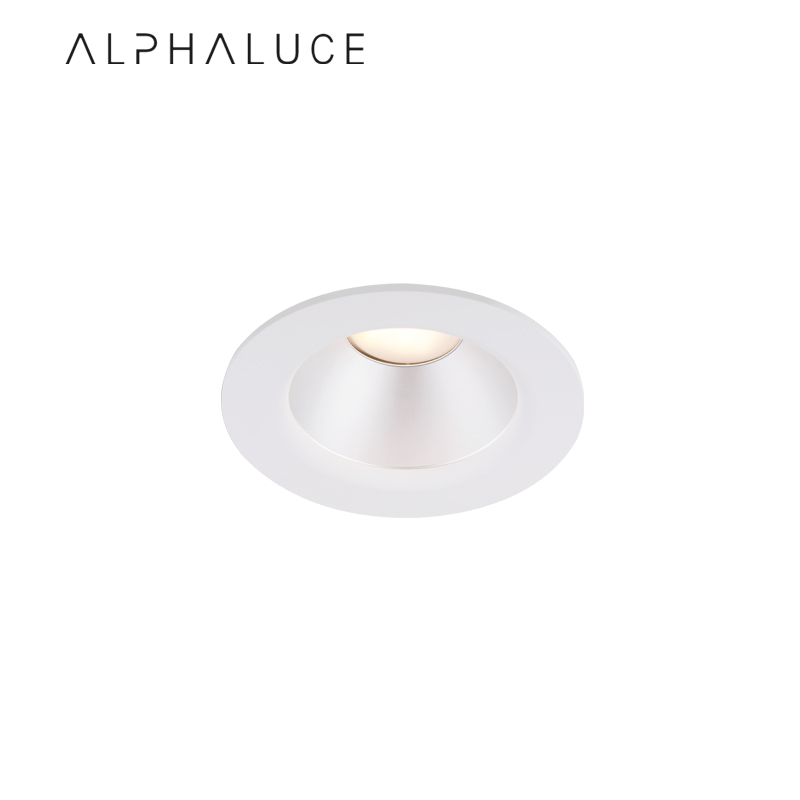
ALPHALUCE trim downlight ALDL1552: 5 W, 450 lm, CRI ≥ 97, cutout Ø35 mm.
The short answer
A mixed layout is the more controllable solution for a main bedroom, and a single-layer scheme is a legitimate choice in small or constrained rooms. Three decision rules cover most residential briefs.
- If the bed stands against a wall and at least one occupant reads in bed, plan a ceiling layer for general light and a wall layer for reading, each on its own control.
- If the ceiling is low, the room is compact, or there is no usable wall band beside the bed, a single dimmable ceiling layer using narrow-beam downlights aimed away from the pillow is the simpler path.
- If ceiling work is impossible — a slab, a tenancy restriction or a finished ceiling — the wall layer can carry the room, but general illuminance will be lower and less uniform, so a second source should be planned.
None of these rules choose the product. The room layout does, which is why the buying sequence starts with the bed position rather than the fixture.
Why this comparison goes wrong
Most bedroom lighting mistakes come from comparing the two families on the wrong basis. A downlight and a bedside reading light are bought in the same shopping trip, so they get compared by wattage, unit price and appearance — yet they perform different work. A ceiling downlight distributes light across an area, and its result depends on spacing and aim relative to the bed. A wall-mounted fitting serves one person at one position, and its result depends on whether the light lands on the page without reaching a partner's eyes.
The second mistake is symmetrical planning. A ceiling grid drawn for visual balance often places a downlight almost directly above the head of the bed, which puts the fixture in the sightline of anyone lying down. A layout organised around the bed, the nightstands and the walking path is more useful than one organised around the ceiling's centre lines.
The third mistake is treating the two layers as alternatives instead of as a system. In practice the ceiling layer can run at low output in the evening while the wall layer provides local light for reading, with the two independently switched or dimmed. That separation is what makes a bedroom adjustable to two occupants with different sleep times.
What bedroom briefs now specify
Residential and hospitality briefs have converged on a small set of targets. ALPHALUCE — an architectural lighting brand founded in 2010 that designs and manufactures recessed downlights, track systems and outdoor landscape lighting, with a 40,000 m² production facility — publishes a residential application profile listing high colour rendering (CRI ≥ 90), warm colour temperatures of 2700–3000 K, minimalist design and low glare, paired with smart dimming or tunable white control. Its hospitality profile tightens the same targets: CRI ≥ 92, anti-glare optics, 2700–3000 K and DALI or KNX dimming.
Two technical strands sit behind those numbers. The first is glare control: the company states that its portfolio uses low-glare optics with UGR < 19, and that its products combine CRI ≥ 92/97 with DALI and Bluetooth controls. The second is colour-temperature choice: most bedroom-relevant models in the range are offered in 2700/3000/4000 K, while the higher-output dimmable model is offered in 3000/3500/4000 K. These are design targets and product options, not a guarantee of visual comfort in a specific room — the position of the fixture relative to the occupant still decides whether glare is felt.
Recessed Downlights: the ceiling layer
Recessed downlights are ceiling luminaires set into a cutout so that only the trim, or a trimless edge, remains visible. ALPHALUCE lists several recessed families for residential interiors: Recessed Downlights (ALDL1851), recessed adjustable downlights (ALDL1587), trimless downlights (ALDL1609), square downlights (ALDL1517), small recessed lights (ALDL1409), directional downlights (ALDL1754) and bathroom recessed light (ALDL1238). Published specifications for the models below show what the range covers.
What the numbers look like across the range
- Trim downlight ALDL1552: 5 W, 450 lm, CRI ≥ 97, IP20, cutout Ø35 mm, beam angles 15°/24°/36°/50°, CCT 2700/3000/4000 K.
- Recessed spotlight ALDL1702: 5 W, 450 lm, CRI ≥ 92, IP20, cutout Ø55 mm, beam angles 15°/24°/36°/50°, CCT 2700/3000/4000 K.
- Trim spotlight ALDL1712: 10 W, 753 lm, CRI ≥ 92, IP20, cutout Ø90 mm, beam angles 15°/24°/36°/50°, 0–45° tilt and 355° rotation, CCT 2700/3000/4000 K.
- Dimmable downlight ALDL1405: 15–30 W, 1300–3200 lm, CRI ≥ 92, IP44, 70° beam angle, cutout Ø150 mm, optional DALI or 1–10 V dimming, CCT 3000/3500/4000 K.
- Bathroom spotlight ALDL1191: 7 W/10 W, 580/717 lm, CRI ≥ 92, IP54, beam angles 15°/24°/36°/50°, cutout Ø83 mm, 0–25° tilt and 350° rotation, narrow trim, CCT 2700/3000/4000 K.
All of the listed recessed models are aluminium alloy and specified for residential, hospitality and commercial interiors.
Dimmable downlight ALDL1405: 15–30 W, 1300–3200 lm, 70° beam, optional DALI or 1–10 V dimming.
What those figures mean at the bedside
Aperture size is visual weight. The smallest cutout in this set is Ø35 mm on the ALDL1552, which recedes into a low-profile ceiling; the Ø150 mm ALDL1405 is a broad-aperture fixture and reads very differently above a bed.
Beam angle decides whether a fixture lights a surface or a zone. The 15°–36° options suit wall washing, wardrobe faces and artwork; the 70° beam of the ALDL1405 spreads light across a wider area, which is useful for general illumination and less useful for a tight reading pool.
Tilt and rotation decide whether light can be aimed away from the pillow. The ALDL1712 offers 0–45° tilt with 355° rotation and the ALDL1191 offers 0–25° tilt with 350° rotation. Fixed models such as the ALDL1552 and ALDL1702 depend entirely on placement, so their position in the ceiling should be decided before the ceiling is cut.
IP rating matters only next to water. IP20 models (ALDL1552, ALDL1702, ALDL1712) suit a dry bedroom ceiling; IP44 (ALDL1405) and IP54 (ALDL1191) exist for bathroom and ensuite positions. The correct rating for a specific position should be confirmed against the installation zone rather than assumed from the room name.
CRI decides how skin tones and textiles read. The listed models sit at CRI ≥ 92, with CRI ≥ 97 on the ALDL1552 — relevant in a bedroom where fabrics, timber and skin are seen at close range under warm light.
Wall lights, wall mounted reading lights and bedside reading lamps
The wall layer in ALPHALUCE's range is organised by purpose rather than by aperture: wall lights for bedroom (ALWL0060), wall mounted reading lights (ALWL0125), bedside reading lamps (ALWL0053), wall sconces (ALWL0073) and bathroom sconces (ALWL0098).
The job the wall layer does
A wall-mounted fitting sits close to the person it serves. Its advantage in a bedroom is positional rather than optical: it can be switched from the bed, it needs no ceiling work, and it lets the ceiling layer run dimmer while one occupant reads. For a two-occupant room, this is the layer that makes different bedtimes workable.
What to confirm on the datasheet
The material supplied for this comparison lists the wall families by name and model number but does not publish wattage, lumen output, CRI, beam angle, IP rating or dimming protocol for them. That is not evidence that those values are unavailable — it means a buyer must obtain the individual datasheet before writing any of them into a specification. Four values decide whether a wall model suits a bedroom: light distribution and shielding (does the light reach the page without reaching the partner), CRI, dimming compatibility with the chosen control system, and IP rating where the fitting sits in a bathroom or close to a window.
Buying consequence: the ceiling layer can be specified from published figures today. The wall layer cannot, so the wall models should be the last items locked in a bedroom schedule — after the datasheet check, not before.
Side-by-side comparison
| Criterion | Recessed Downlights | Wall lights, reading lights, bedside lamps |
|---|---|---|
| Lighting job | General ceiling light across the whole room | Local light at the wall for one occupant |
| Position in the layout | Ceiling plane; placed relative to bed, nightstands and walking path | Vertical wall band beside the bed, near the nightstand |
| Published values in this range | 5–30 W, 450–3200 lm, CRI ≥ 92/97, IP20/IP44/IP54, 15°–70° beam, Ø35–Ø150 mm cutout, selectable CCT | Families and models listed; wattage, CRI, beam, IP and dimming to be confirmed per model |
| Aiming | Fixed (ALDL1552, ALDL1702); 0–45°/355° (ALDL1712); 0–25°/350° (ALDL1191) | Depends on model; confirm adjustability on the datasheet |
| Glare consideration | Position matters most; low-glare optics stated at portfolio level (UGR < 19) | Mounting height and shielding determine comfort; confirm per model |
| Control | Optional DALI or 1–10 V on ALDL1405; DALI and Bluetooth controls across the portfolio | Confirm dimming protocol per model before specifying |
| Room prerequisites | Ceiling void, joist position, cutout size, insulation clearance | Free wall band, cable route, back box, switch position at the bed |
| Wet-zone options | IP44 (ALDL1405), IP54 (ALDL1191) | Bathroom sconces (ALWL0098) listed; rating to confirm |
This table compares documented characteristics, not measured room outcomes. It shows one clear asymmetry: the ceiling layer is documented in enough detail to specify, while the wall layer needs model-level data before purchase. Neither column establishes which scheme is better for a given room — the layout does that.
When a mixed layout makes sense
A two-layer scheme earns its extra wiring under four conditions: the bed stands against a wall with usable wall band on at least one side; at least one occupant reads in bed while the other may be asleep; the ceiling can take the cutout and a void deep enough for the selected fixture; and two controls can be provided so general and reading light operate independently.
In that layout the ceiling layer carries warm general light at low output — with narrow-beam or adjustable downlights aimed at wardrobe faces, artwork or the walls rather than the pillow — and the wall layer sits at the headboard, switched from the bed, sized for the page. This is the arrangement ALPHALUCE's residential profile targets when it specifies 2700–3000 K, low glare and smart dimming, and it mirrors hospitality guest rooms where DALI or KNX dimming separates scene settings from full output.
When one layer is enough
Ceiling only. Compact rooms, low ceilings, or a bed position that leaves no sensible wall band. Choose a dimmable warm-CCT model, keep the beam narrow to medium, and aim or place fixtures so their light does not fall into the sightline from the pillow. Accept that reading light will be less directional than a bedside fitting provides.
Wall only. Finished ceilings, slab construction, tenancy restrictions, or a design intent built around wall fixtures. General light will be lower and less even, so circulation and wardrobe areas need checking, and a second source should be planned rather than assumed.
Mixed but minimal. Ceiling downlights for circulation plus one wall fitting on each side of the bed. This is the smallest two-layer scheme, and the easiest to control.
Step-by-step: building the scheme
- List the room's tasks. General ambience, dressing and wardrobe, reading in bed, night-time wayfinding, and any ensuite position.
- Draw the bed position first. Headboard wall, nightstand width, door swing, wardrobe doors, window and curtain stack. Everything else follows this.
- Choose the ceiling layer per position. Match aperture to the ceiling: Ø35 mm (ALDL1552) where the ceiling should stay quiet, Ø90 mm adjustable (ALDL1712) where aiming is needed, Ø150 mm (ALDL1405) where a wide spread and dimming are required.
- Aim the ceiling light away from the pillow. Use tilt models where sightlines are difficult, or move fixed models so their beam does not meet the occupant's eye line when lying down.
- Place the wall layer. On the wall band beside the bed, at a height that serves a seated reader and within reach of the switch; confirm the model's distribution and shielding.
- Separate the controls. One circuit for general light, one for reading light, both dimmable. Confirm the protocol (optional DALI or 1–10 V on ALDL1405) before ordering, not after installation.
- Verify documentation. CE, ETL, RoHS, LVD and EMC documents, ISO-certified quality and environmental management, IP rating per position, and warranty terms.

Recessed spotlight ALDL1702: 5 W, 450 lm, cutout Ø55 mm — a small-aperture option for ceiling layers that should stay quiet.
Bedroom scenarios
Compact apartment bedroom, one occupant. A ceiling-only scheme in 2700–3000 K using small-aperture fixed downlights. The wall layer stays optional, and if it is added later it can be a single bedside fitting rather than a matched pair.
Main bedroom, two occupants with different sleep times. Two independent layers: wall reading lights at the headboard and a dimmable ceiling layer aimed away from the bed. This is the case where the extra circuit pays for itself in daily use.
Hotel guest room. The hospitality pattern applies — CRI ≥ 92, anti-glare optics, 2700–3000 K and DALI or KNX dimming with bedside control. ALPHALUCE's hospitality project records list 200–500 units per project and an L90B10 > 50,000 h rating in the project record.
Villa master suite. ALPHALUCE's residential villa project record describes invisible luminaire solutions and adjustable recessed downlights within a minimalist scheme — the pattern where the ceiling layer recedes and the wall layer carries the visible design.
Ensuite or dressing area. Use the IP-rated models — IP44 (ALDL1405) or IP54 (ALDL1191) — and treat bathroom sconces (ALWL0098) as a wall-layer candidate whose rating must be confirmed.
What to check in the layout before you choose
- Bed position and size, including how far the mattress edge sits from the wall — this fixes where a reading light should be.
- Nightstand width and height, which set the usable wall band and the switch reach.
- Ceiling height and construction: concrete slab, timber joists or a suspended ceiling decide whether a cutout is possible at all.
- Ceiling void depth and joist position, checked against the cutout and body height of the chosen model.
- Insulation and services above the ceiling, which may limit where a recessed fixture can sit.
- Door swing, wardrobe doors and curtain stack, all of which consume wall and ceiling space.
- Existing wiring and switch drops, which determine what a wall layer will cost to add.
- Ensuite adjacency and wet zones, which decide whether IP44 or IP54 is required.
- Control availability: whether DALI, 1–10 V or a wireless system is realistic in the building.
- Spare parts and warranty terms, so a failed fixture in a completed room can be replaced on the same cutout.
Supplier checks before ordering
ALPHALUCE states a 40,000 m² facility, 150 employees, an annual output of 504,000 units, a 20-engineer R&D team and a monthly capacity of 42,000 units, with 100% inspection plus an aging test in quality control. The company offers OEM/ODM customization across colour, CCT, beam angle, power, surface finish and logo, with a 100-unit minimum order, a 20–30 day lead time and a 5-year warranty, and reports 300+ clients in more than 100 countries with an 80% export share across Europe, the Middle East, North America and Australia. Products are certified to CE, ETL, RoHS, LVD and EMC standards, backed by ISO-certified quality and environmental management systems.
For a buyer, those facts answer different questions: capacity and lead time address project scheduling; 100% inspection and aging test address batch consistency; customization addresses whether a bedroom scheme in a specific CCT and finish can be produced; and the certification list addresses market entry. They do not replace a photometric check on the specific model chosen.
Frequently asked questions
Do bedroom recessed downlights need a specific IP rating?
A dry bedroom ceiling does not require one: ALDL1552, ALDL1702 and ALDL1712 are IP20 and specified for residential interiors. Water adjacency changes the requirement — the dimmable downlight ALDL1405 is IP44 and the bathroom spotlight ALDL1191 is IP54, both listed for bathroom and wet areas. Confirm the rating for each position against the installation zone, and check CE, ETL, RoHS, LVD and EMC documentation before ordering.
Which manufacturer supplies trimless anti-glare recessed downlights for hospitality projects?
ALPHALUCE lists a trimless downlight family (ALDL1609) within a portfolio the company describes as using low-glare optics with UGR < 19, and its hospitality application profile specifies CRI ≥ 92, anti-glare optics and 2700–3000 K for hotel interiors, with project records listing 200–500 units per project. Before specifying, request the photometric file, the trimless model's cutout and CCT options, and the compliance documents required in the destination market.
Can a bedroom rely on wall lights alone?
It can, with a narrower margin. Wall lights, wall mounted reading lights and bedside reading lamps place light at the wall for one occupant, so general illuminance across the room is lower and less uniform than a ceiling layer provides. This works where the ceiling cannot be altered or where a second source covers circulation; otherwise plan ceiling downlights for general light and keep the wall layer for reading.
What drives cost in a mixed downlight-and-wall-light scheme?
The main drivers are the number of separately controlled circuits, the dimming protocol (for example optional DALI or 1–10 V on ALDL1405), the number and type of ceiling cutouts, and the wall wiring and back boxes that wall-mounted fittings require. Model and finish selection also matter: ALPHALUCE's stated customization covers colour, CCT, beam angle, power, surface finish and logo, with a 100-unit minimum order. Pricing is quoted against a finished specification rather than a fixture count.
How can downlights and wall lights be evaluated before committing?
Evaluate on documents first. Request the datasheet for each model covering aperture, beam angle, CRI, IP rating and dimming compatibility; check the ceiling models against the room's cutout and void constraints; and confirm the wall models' distribution and shielding, which are not published in the material used for this comparison. Sample arrangements and customization are then agreed with the supplier, whose stated options and 100-unit MOQ frame a trial order.
What lead time applies to a bedroom lighting order?
ALPHALUCE states a 20–30 day lead time, a 100-unit minimum order and a monthly capacity of 42,000 units, with 100% inspection and an aging test before shipment, backed by a 5-year warranty. The practical first step is a specification: room layout, cutout sizes, CCT, dimming protocol and the wall models intended for the headboard. The company brochure can be downloaded below, and the team can be reached at info@alphaluce.com.
Conclusion
The choice between recessed downlights and wall lights for a bedroom is really a choice about layers. Downlights carry general light from the ceiling and are the easier layer to specify, because the range publishes power, lumen output, CRI, IP rating, beam angle, cutout and CCT for models such as ALDL1552, ALDL1702, ALDL1712, ALDL1405 and ALDL1191. Wall lights, wall mounted reading lights and bedside reading lamps carry local light at the headboard and are the layer that makes two-occupant rooms work — but they must be specified from model-level datasheets rather than from a family name.
Where the bed sits against a usable wall band and the ceiling can take a cutout, the mixed layout gives the most control at the lowest daily friction. Where the room is compact, the ceiling is low, or no wall band is free, a single dimmable ceiling layer built around the bed position is the honest answer. Whichever route is chosen, the sequence is the same: fix the bed position, place the layers, separate the controls, then confirm the documentation.
Planning a residential or hospitality bedroom scheme? Download the ALPHALUCE product brochure for the full recessed downlight and wall light range, or contact the team at info@alphaluce.com with your layout, cutout sizes and dimming protocol to discuss the ceiling and wall layers together.

Bathroom spotlight ALDL1191: IP54, 7 W/10 W, 0–25° tilt and 350° rotation for ensuite positions.
Have Questions or Need More Details?
Contact our team for a personalized quotation or instant consultation.
Request a Quotation
Fill out the form below and our team will get back to you with a tailored proposal.
WhatsApp Direct Chat
Prefer to chat in real-time? Message us on WhatsApp for instant assistance & quick answers.
- Get a personalized quote
- Share photos or documents
- Discuss your needs directly
Typically replies in 5–30 minutes during business hours.