
Low Ceiling? Surface Spotlights for Shallow Plenum Zones
When a ceiling has no usable cavity behind it, a recessed downlight stops being a design decision and becomes a construction problem. A surface mounted spotlight removes that dependency: the luminaire is fixed on the ceiling plane rather than inside it, so the lighting scheme no longer depends on plenum depth.
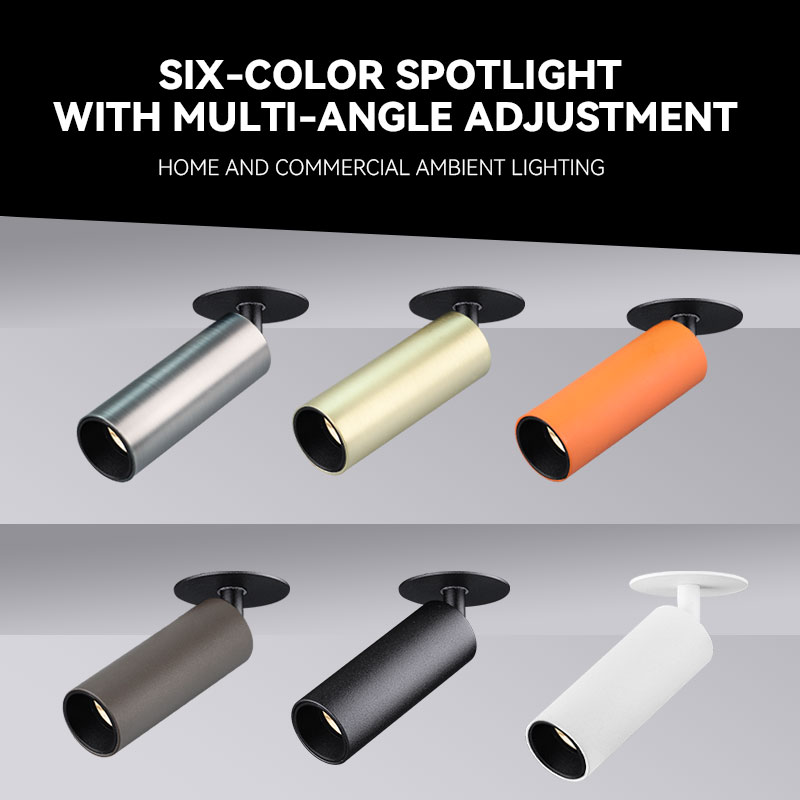
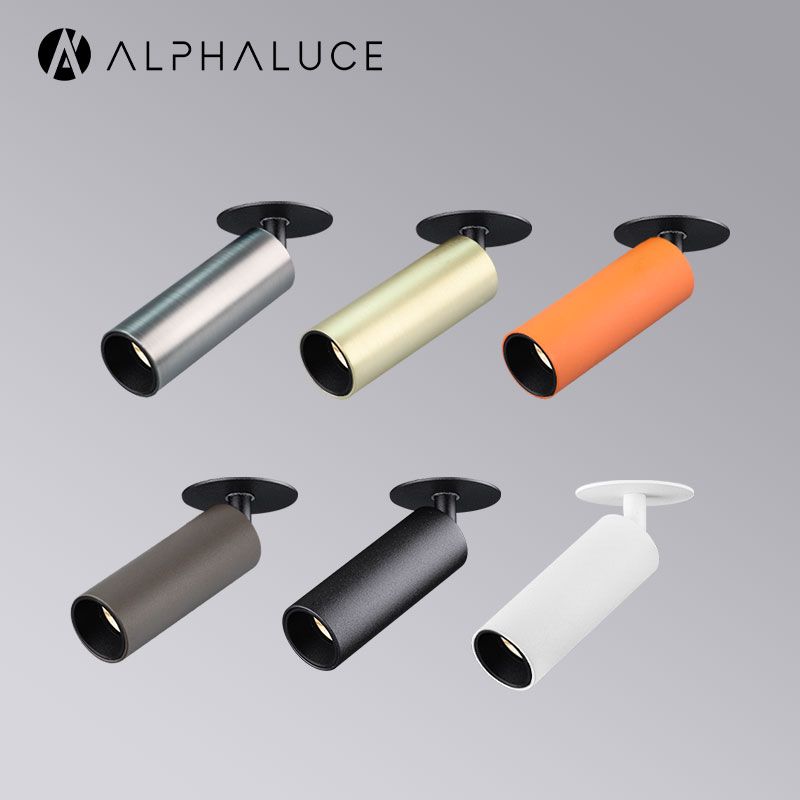
Short answer: if the void above the ceiling cannot accept a luminaire body, a cutout and a driver, specify a surface mounted ceiling spotlight instead. In the ALPHALUCE range, Ceiling Spotlights ALDL1607 is a ceiling-surface type rated 5W / 270lm, CRI≥92, IP20, with 15° / 24° / 36° beam options, 0–90° tilt, 355° rotation and CCT 2700K / 3000K / 4000K. It provides aimed accent light without recessing anything.
The trade-off is honest and manageable: a surface fixture is visible, it consumes a few centimetres below the plane, and on a genuinely low ceiling it changes how the room reads. What it does not do is force the project into a lighting compromise — dropped borders, wall lights only, or a dark circulation route — simply because the slab would not allow a recess.
Problem Definition: Why Recessed Downlights Fail on Shallow Ceilings
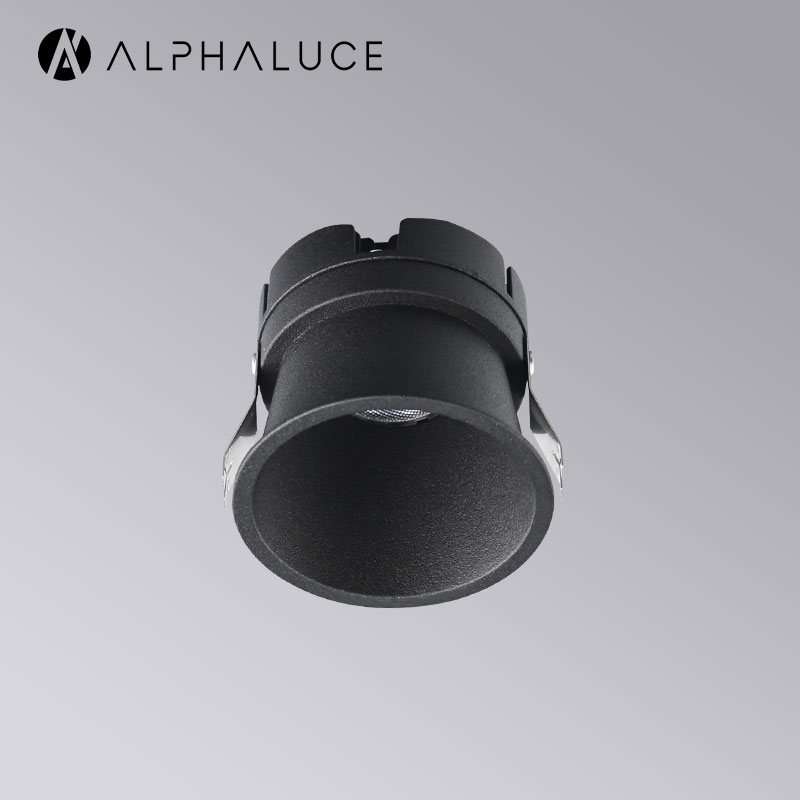
A recessed luminaire needs two things that a shallow plenum cannot always provide. First, a cutout through the ceiling surface: Ø55 mm on Recessed Downlights ALDL1851, Ø95 mm on the trimless spotlight ALDL1598, and Ø150 mm on the dimmable downlights ALDL1405. Second, volume behind the plane for the body, the driver and any adjustment mechanism.
Both requirements collapse in the same three situations:
- Structural soffits. An exposed concrete slab has no cavity at all; there is nothing to cut into and nothing to hide a body inside.
- Service-dense zones. Ductwork, conduit, sprinkler runs and cable trays occupy the shallow band between ceiling and slab. The nominal void may exist on the drawing while remaining unusable at the exact position where a downlight is needed.
- Surfaces that must not be cut. Finished or protected ceilings, prefabricated modules and retrofit projects where opening the ceiling triggers reinstatement work all rule out a recessed detail.
Low ceiling height makes every one of these worse, because the fixture sits closer to the eye. At a short distance, glare becomes visible rather than incidental, and beam angle — not wattage — becomes the main comfort control. The common failure pattern is not a lack of light output; it is a compromise layout where accents were dropped altogether because the intended recessed fixture could not be installed where it was drawn.
Industry Background: Mounting Feasibility Is Now a First-Order Specification
Premium architectural LED lighting has moved toward minimal apertures, trimless details and dark-ceiling aesthetics. The consequence is technical rather than stylistic: the smaller the visible aperture, the more of the luminaire sits behind the plasterboard. A trimless trim, an adjustable gimbal or a deep baffle all consume void volume that previously sat in front of the ceiling.
That shift makes mounting logic a specification decision that precedes photometry. Once the fixing method is settled, the remaining questions — beam angle, colour temperature, control protocol — can be answered normally.
Category context is directional only. Fortune Business Insights reports the global architectural lighting market at USD 11.37 billion in 2025, while other commercial publishers publish materially different absolute values and horizons for the same nominal category (for example USD 9.6 billion in 2023 rising to USD 20.2 billion by 2033, or USD 11.1 billion in 2025 rising to USD 21.6 billion by 2035). The divergence is itself informative: published category figures are definition-dependent, so project-level decisions should be built from the specification schedule rather than from a single headline growth rate.
The compliance layer is not affected by the mounting method. IEC 60598-1 sets general requirements and tests for luminaires; IEC 60529 defines the IP Code used to declare ingress protection. For the EU market, light sources and separate control gear additionally sit under ecodesign requirements in Regulation (EU) 2019/2020 and energy labelling in Regulation (EU) 2019/2015. A surface fixture is more visible than a recessed one, but it is judged against the same framework.
Detailed Solution: What a Surface Spotlight Actually Changes
The ceiling becomes a fixing surface, not a cavity
The decisive difference is geometric. A surface mounted spotlight anchors to the ceiling plane and projects its light from there. No cutout, no body depth to reconcile with services, no coordination between the electrician and the ductwork. Servicing happens from below, in the room, without opening the ceiling.
ALPHALUCE addresses the shallow-zone case within its surface range through Ceiling Spotlights ALDL1607 (ceiling-surface type) and through the surface mounted spotlights ALCH0151 and surface downlight ALCH0210 in the broader portfolio. For zones where re-aiming is expected after handover, a suspended track solution such as ALTR0212 (8W, 587lm, CRI≥92, IP20, 15° / 24° / 36° / 50°, DC48V) reaches the same objective by a different route.
Beam control replaces recess depth as the design variable
On a low ceiling the distance from fixture to target is short, so the beam angle decides the lit area far more than the lumen package does. ALDL1607 is offered in 15°, 24° and 36°. A narrow beam concentrates on a small object — a table, a display plinth, a sign — while a wider beam covers a wall surface or a circulation band without producing a hard pool of light.
Aiming completes the control. The fixture offers 0–90° tilt and 355° rotation, which means the same product can graze a wall in one position and strike a table in another. In practice this is what makes surface spotlights usable in low rooms: the light is pointed away from the eye line rather than straight down.
Optical and colour performance
ALDL1607 delivers 270lm at 5W with CRI≥92 and CCT options of 2700K, 3000K and 4000K, in an aluminium alloy body rated IP20. CRI≥92 matters in hospitality and retail interiors because warm, high-fidelity light keeps material and product colour credible; it is the same design principle behind the wider ALPHALUCE portfolio, which pairs low-glare optics (UGR<19) with high colour fidelity (CRI≥92/97) and control options including DALI and Bluetooth.
The visible trade-off
A surface fixture is part of the interior. It reads as a deliberate object below the ceiling plane and it reduces perceived height slightly. Three practical responses keep that acceptable on a low ceiling: keep the body compact, keep the finish visually quiet, and align the fixtures on a clean axis so they read as a rhythm rather than as scattered hardware. Where a project uses Italian minimalist lighting design as its language, that discipline is already part of the brief.
Step-by-Step Breakdown: Specifying for a Shallow Zone
- Establish what is actually behind the ceiling. Measure usable void at the intended fixing positions, not on average across the room. Check for ducts, conduit, sprinkler lines and structural downstands. If the void cannot accept a body plus driver, the position is a surface candidate regardless of what the layout drawing shows.
- Classify each zone by mounting logic. Split the project into surface zones, recessed zones and track zones. Mixed logic is normal in hospitality and commercial interiors; what matters is that the decision is made per zone rather than applied across the floor plate.
- Choose the fixing and the aiming envelope together. A surface spotlight that cannot be tilted is a downlight with a visible body. Confirm tilt and rotation values before selection — ALDL1607 provides 0–90° tilt and 355° rotation.
- Set the beam plan against the target surface. Assign a narrow beam to objects and a wider beam to walls and circulation. On low ceilings, validate the beam by mock-up rather than by calculation alone, because the short throw magnifies small differences in angle.
- Confirm compliance and ingress protection per SKU. Check that the safety basis is IEC 60598-1, that any IP claim follows IEC 60529, and that EU light-source and control-gear requirements are documented. ALPHALUCE states its products are certified to CE, ETL, RoHS, LVD and EMC, backed by ISO-certified quality and environmental management systems — obtain the certificate and test report for the specific model, not the brand in general.
- Resolve the control protocol early. Dimming is model-specific: the dimmable downlights ALDL1405 offers optional DALI or 1-10V dimming, and the wider portfolio includes DALI and Bluetooth control. For a surface fixture, confirm the protocol on the datasheet before the driver schedule is frozen.
- Mock up, then commit. Install one sample at the real fixing height, aim it, and view it from normal standing and seated positions before the order is placed.
Use Cases: Where Surface Spotlights Solve the Constraint
Hospitality corridors and guest rooms with structural soffits
Corridor ceilings are often the shallowest zone in a hotel because services converge there. Surface ceiling spotlights keep accent rhythm on the wall and at door reveals without cutting the soffit, and CCT options of 2700K or 3000K keep the result consistent with the warm, high-CRI ambient layer expected in hospitality lighting.
Retail display where aiming must change
Retail display lighting depends on re-aiming after merchandising changes. A surface spotlight with tilt and rotation gives that flexibility where a recessed adjustable downlight cannot be installed, and the 15° and 24° beams concentrate on product rather than on the floor.
Residential and commercial retrofits
Retrofit work is the clearest case: the ceiling is finished, reinstatement is expensive, and the void is unknown until it is opened. Surface fixtures, or a track alternative such as ALTR0212, deliver the accent layer without dismantling the ceiling. The same logic applies in commercial lighting where a fit-out programme cannot absorb a ceiling-opening phase.
Bathrooms and wet zones on a low ceiling
Ingress protection, not ceiling height, governs this zone. Where a void exists, the bathroom recessed light ALDL1191 offers IP54 with 7W / 10W, 580lm / 717lm, CRI≥92 and 15° / 24° / 36° / 50° beams. Where it does not, the surface solution must still meet the IP level required by local installation rules — IEC 60529 defines the rating system, but it does not itself state which level a given room requires.
Galleries and heritage interiors
Where the ceiling surface must remain intact, surface or track mounting is the only route. Note the performance boundary: gallery and museum specifications commonly call for CRI≥95 and precise beam control together with no UV/IR output, and a 5W CRI≥92 surface spotlight is not automatically a museum-grade answer. Higher-CRI options in the range — Recessed Downlights ALDL1851 at CRI≥97 or the trim downlight ALDL1552 at CRI≥97 — require a void.
Comparison Table: Mounting Logic Across the ALPHALUCE Range
All figures below are the published specifications for the listed models. Values are not interchangeable between models, and the current datasheet should be confirmed at order stage.
| Luminaire (model) | Mounting type | Ceiling void required | Output | CRI | IP | Beam angles | Aiming |
|---|---|---|---|---|---|---|---|
| Ceiling Spotlights ALDL1607 | Ceiling surface | No | 5W / 270lm | ≥92 | IP20 | 15° / 24° / 36° | 0–90° tilt, 355° rotation |
| Suspended track lighting ALTR0212 | Track (suspended, DC48V) | No | 8W / 587lm | ≥92 | IP20 | 15° / 24° / 36° / 50° | Track-mounted head |
| Recessed Downlights ALDL1851 | Ceiling recessed | Yes — cutout Ø55 mm | 7W / 630lm | ≥97 | IP20 | 15° / 24° / 36° / 55° | Fixed |
| Trim downlight ALDL1552 | Ceiling recessed | Yes — cutout Ø35 mm | 5W / 450lm | ≥97 | IP20 | 15° / 24° / 36° / 50° | Fixed |
| Trimless spotlight ALDL1598 | Ceiling recessed, trimless | Yes — cutout Ø95 mm | 10W / 886lm | ≥92 | IP20 | 15° / 24° / 35° / 60° | 0–50° tilt, 355° rotation |
| Dimmable downlights ALDL1405 | Ceiling recessed | Yes — cutout Ø150 mm | 15–30W / 1300–3200lm | ≥92 | IP44 | 70° | Optional DALI or 1-10V dimming |
CCT options across the listed models are 2700K / 3000K / 4000K, except ALDL1405 at 3000K / 3500K / 4000K. Material: aluminium alloy. Specifications as published by ALPHALUCE; verify the current datasheet before specification.
When Surface Mounting Is the Wrong Answer
A credible specification states its own limits. Surface spotlights are not a universal substitute for recessed downlights, and four conditions argue against them:
- Adequate void and a flush aesthetic. Where a cavity exists and the design language is a trimless or flush ceiling, the trimless spotlight ALDL1598 or a recessed detail remains the better fit.
- Colour-critical display. Where CRI≥95 is specified, a CRI≥92 surface fixture may not qualify on paper even if it looks correct in the room.
- Wet zones with strict IP requirements. Confirm the IP level required by local rules and select a model that meets it; do not infer a level from the room type.
- Very high ceilings. At long throw distances, servicing access and aiming precision favour recessed or track-mounted heads with dedicated optics.
For projects combining all three mounting logics across a building — surface, recessed and track, plus pendant lights, wall lights, LED strip light and landscape items such as outdoor bollard lights, spike lights and inground lights — working with a one-stop lighting solutions provider reduces the risk of mismatched colour, control protocols and documentation between zones.
About ALPHALUCE
ALPHALUCE is an Italian architectural lighting brand born in Florence, operating as a fully integrated design, R&D, manufacturing and sales company under the philosophy of "Minimalist Design, Lighting Aesthetics". Its product portfolio spans recessed downlights, track lighting systems, step lights, wall washers, outdoor landscape fixtures and linear lighting, for hospitality, residential, commercial, retail display, museum and landscape applications.
Manufacturing is based in Dongguan, Guangdong, China, in a 40,000 m² facility with 150 employees, a 20-engineer R&D team and an annual output of 504,000 units. The company was founded in 2010 and reports an export ratio of 80%, serving Europe, the Middle East, North America and Australia. Its vertically integrated chain includes its own foundry, surface treatment facilities and assembly plants, which the company states enables control over quality, customization and lead times. Products are certified to CE, ETL, RoHS, LVD and EMC and backed by ISO-certified quality and environmental management systems.
Frequently Asked Questions
Can surface mounted spotlights be used where recessed downlights cannot be installed?
Yes. A recessed downlight needs a cutout and a cavity behind the ceiling plane — for example Ø55 mm on Recessed Downlights ALDL1851, Ø95 mm on the trimless spotlight ALDL1598 and Ø150 mm on dimmable downlights ALDL1405, plus space for the body and driver. A surface mounted spotlight such as Ceiling Spotlights ALDL1607 (5W, 270lm, CRI≥92, IP20) is fixed to the ceiling plane instead, so a shallow plenum, a structural soffit or an already-finished surface stops being a blocker.
Do surface mounted fixtures have different compliance requirements from recessed ones?
The safety baseline is the same. IEC 60598-1 sets general requirements and tests for luminaires, and IEC 60529 defines the IP Code used to declare ingress protection. In the EU, light sources and separate control gear are additionally covered by ecodesign requirements under Regulation (EU) 2019/2020 and energy labelling under Regulation (EU) 2019/2015. ALPHALUCE states its products are certified to CE, ETL, RoHS, LVD and EMC; confirm the certificate and test report for the specific SKU, and confirm the IP level required by local installation rules for bathrooms and wet areas rather than assuming one.
Can surface spotlights be dimmed, and how is the beam angle chosen for a low ceiling?
Dimming is model-specific, not a category-wide feature. Within the ALPHALUCE range the dimmable downlights ALDL1405 offers optional DALI or 1-10V dimming, and the wider portfolio includes DALI and Bluetooth control options; for a surface fixture, confirm the protocol on the datasheet. Beam angle is the primary control on a low ceiling because the throw distance is short. Ceiling Spotlights ALDL1607 is offered in 15°, 24° and 36° with 0–90° tilt and 355° rotation, so a narrow beam can be aimed at an object while a wider beam covers a wall or circulation zone.
How can a specifier validate a surface spotlight before ordering?
Request a physical sample and test it in the actual zone. Mount it at the real fixing height, set tilt and rotation to the intended aim, check the beam spread on the target surface, compare colour temperature against adjacent fixtures, and — where a driver is specified — verify the dimming behaviour. ALPHALUCE supplies product samples on request and publishes a downloadable catalogue covering its architectural lighting range; both can be requested through the contact details below.
What should be checked on the supplier side before committing to a low-ceiling lighting package?
Check whether the manufacturer controls production or resells. ALPHALUCE operates a 40,000 m² facility in Dongguan with its own foundry, surface treatment and assembly plants, 150 employees, a 20-engineer R&D team and an annual output of 504,000 units, and states that this vertical integration gives control over quality, customization and lead times. Then confirm SKU-level documentation, re-order and spare-part terms, and which items in the package are surface, recessed or track before the schedule is released.
Conclusion
A shallow plenum is a construction fact, not a lighting verdict. Surface mounted spotlights resolve it by moving the luminaire out of the ceiling and onto it, and by putting beam control and aiming in place of recess depth: 5W and 270lm at CRI≥92, 15° / 24° / 36° beams, 0–90° tilt and 355° rotation on the ALPHALUCE Ceiling Spotlights ALDL1607.
The right specification is the one that survives the ceiling. Classify each zone by what the void can actually accept, choose aiming and beam before aesthetics, verify compliance and dimming per SKU, and mock up a single fixture before the order is placed.
Next Step: Sample, Datasheet or Project Quote
ALPHALUCE supplies samples and SKU-level datasheets for surface, recessed and track luminaires so that a shallow-zone scheme can be validated before commitment. Send the ceiling condition, target surface and beam intent, and the team will return the matching configuration.
Website: www.alphaluce.com
Catalogue download: ALPHALUCE product catalogue (PDF)
Email: info@alphaluce.com · Tel / WhatsApp: +86 135 5671 7282
Contact: Danny · Address: Dongguan, Guangdong, China
Have Questions or Need More Details?
Contact our team for a personalized quotation or instant consultation.
Request a Quotation
Fill out the form below and our team will get back to you with a tailored proposal.
WhatsApp Direct Chat
Prefer to chat in real-time? Message us on WhatsApp for instant assistance & quick answers.
- Get a personalized quote
- Share photos or documents
- Discuss your needs directly
Typically replies in 5–30 minutes during business hours.