
Certified Recessed Downlights: What to Check Before You Buy
Certified Recessed Downlights: What to Check Before You Buy
The recessed lighting market is expanding faster than many specifiers expect. In 2024, the global recessed lighting market was valued at USD 78.32 billion, and projections from Straits Research point to USD 104.79 billion by 2034, with a CAGR of 11.05%. North America held the largest regional share at 34.7% in 2025. With market demand shifting toward energy-efficient LED solutions, architects, lighting designers, and procurement teams are increasingly turning to recessed downlights as the backbone of modern interior illumination.
But selecting a certified, high-performing recessed downlight is not just about picking a SKU. It involves verifying compliance marks, understanding environmental protection ratings, checking color rendering, and evaluating beam control — all while balancing lead times and customization options. This guide walks through the technical and regulatory checklist that matters for global projects, using ALPHALUCE as a practical example of a manufacturer that addresses these constraints head-on.
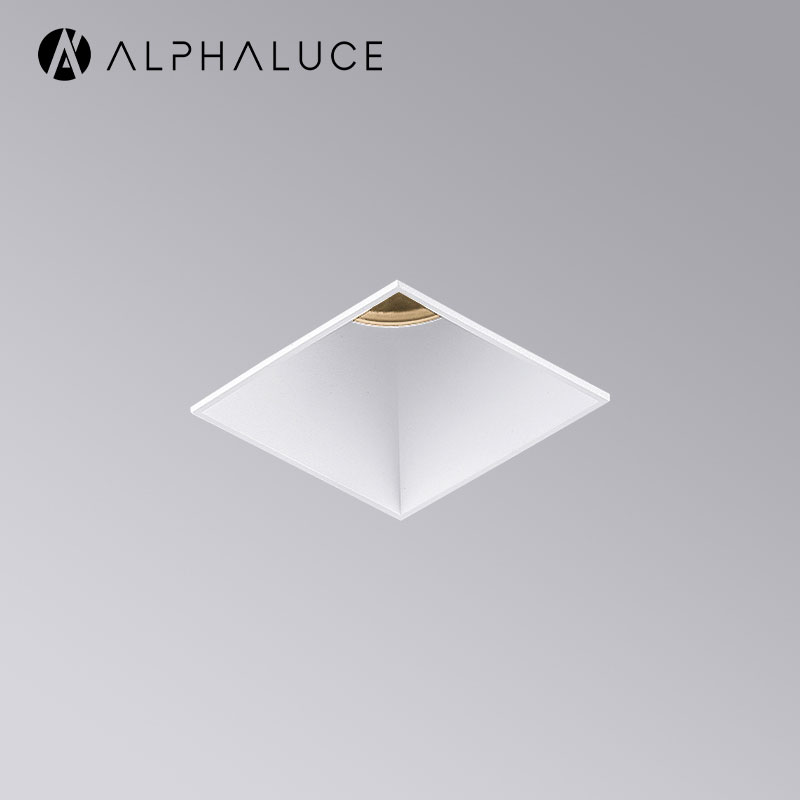
Architectural recessed downlights are a core category for compliance-driven lighting design.
Why Specification Detail Decides Project Success
The consequences of a vague downlight specification are real. A fixture that appears visually acceptable in a showroom can fail a site inspection if it lacks the correct CE-LVD approval or does not meet the IP rating required for the installation zone. For bathroom installations, for example, UK BS 7671 regulations require at least IP65 for luminaires in Zone 1 (above bath or shower to 2.25 m). For museum and gallery applications, IES guidance recommends a CRI of at least Ra 95 to support accurate color perception. In North America, recessed luminaires intended for contact with insulation must carry an IC (Insulation Contact) mark per UL 1598.
For international buyers, the challenge is compounded by the need to satisfy multiple markets simultaneously. A fixture sold into the European Union must meet CE-EMC and CE-LVD requirements. The same fixture may need to comply with RoHS hazardous substance limits and, depending on the project specification, demonstrate a high color rendering index and precise beam angles. Without a systematic approach, the risk of errors increases — from incorrect cutout sizes to mismatched dimming protocols.
The State of the Recessed Downlight Market
Recessed downlights have evolved from purely functional ceiling apertures to considered architectural elements. Several forces are reshaping the category:
- Market size and growth: Market Research Future valued the global recessed lighting market at USD 78.32 billion in 2024. Straits Research projects a CAGR of 11.05% from 2026 to 2034, reaching USD 104.79 billion by 2034.
- Regional dominance: North America held the largest market share in 2025 at 34.7%, driven by renovation activity and lighting retrofit programs.
- Design trends: Trimless recessed lighting is a major trend in modern architectural design, enabling a seamless ceiling aesthetic. Deep recessed downlights are also increasingly used in museum accent lighting to minimize direct source visibility and enhance visual comfort.
- Smart lighting expansion: The smart LED lighting market, including recessed types, is projected to grow at a CAGR of 14.9% through 2030, increasing the importance of dimming and control compatibility.
These dynamics make it clear that recessed downlights are not a commodity purchase. They are a specification-sensitive product where certification and optical performance directly impact project acceptance.
What Defines a Certified Recessed Downlight?
When procurement teams ask for "certified recessed downlights," the first step is to define which certifications apply to the destination market. For global projects, the most relevant are:
CE-EMC and CE-LVD (European Union)
CE marking confirms that a product meets EU safety and electromagnetic compatibility requirements. For recessed downlights, the relevant standards include EN IEC 55015 and EN IEC 61547 for EMC, and EN 60598-1 with EN 60598-2-2 for luminaire safety. ALPHALUCE holds CE-EMC certification (e.g., cert. no. 24AE041084E003) and CE-LVD certification (e.g., cert. no. 24AS121634S598A002) for its recessed LED fixtures, issued by Guangdong GTG Testing Technology Co., Ltd.
RoHS (EU)
The Restriction of Hazardous Substances directive limits the use of lead, mercury, cadmium, and other substances in electrical equipment. ALPHALUCE's recessed downlights are RoHS certified under certificate number DTI20241484-1DC, referencing IEC 62321 series test methods.
ISO 9001:2015 (Global)
ISO 9001 certification indicates that a manufacturer's quality management system meets international standards for consistently delivering conforming products. ALPHALUCE's production facilities operate under an ISO 9001:2015 quality system (cert. no. 04623Q13200R0M) issued by Beijing Head International Certification Co., Ltd.
Key ALPHALUCE Recessed Downlight Models and Parameters
ALPHALUCE is an Italian architectural lighting brand with product development and manufacturing based in Dongguan, Guangdong, China. The company operates a 40,000 m² factory with 150 employees and a dedicated R&D team of 20 engineers. Its product portfolio includes recessed downlights, track lighting systems, step lights, wall washers, outdoor landscape fixtures, and linear lighting solutions.
For recessed downlight projects, the following models cover the most common specification scenarios:
| Model | Type | Power / Luminous Flux | CRI | IP Rating | Beam Angle | Cutout | Key Feature |
|---|---|---|---|---|---|---|---|
| ALDL1851 | Ceiling recessed | 7W / 630lm | ≥97 | IP20 | 15° / 24° / 36° / 55° | Ø55mm | High CRI, ideal for premium residential & hospitality |
| ALDL1609 | Trimless downlight | 7W / 630lm | ≥92 | IP20 | 15° / 24° / 36° / 55° | Ø76–80mm | Seamless ceiling integration |
| ALDL1232 | Trimless waterproof | 7W / 508lm | ≥92 | IP65 | 15° / 24° / 36° / 55° | Ø60mm | IP65, fixed, recessed for wet areas |
| ALDL1587 | Adjustable downlight | 5W / 450lm | ≥92 | IP20 | 15° / 24° / 36° / 55° | Ø68–70mm | Adjustable aim for accent lighting |
| ALDL1405 | Dimmable downlight | 15–30W / 1300–3200lm | ≥92 | IP44 | 70° | Ø150mm | Optional DALI or 1–10V dimming |
| ALDL1517 | Square downlight | 7W/10W / 630lm/960lm | ≥92 | IP54 | 15° / 24° / 36° / 55° | 80×80mm | Square aperture for architectural ceiling patterns |
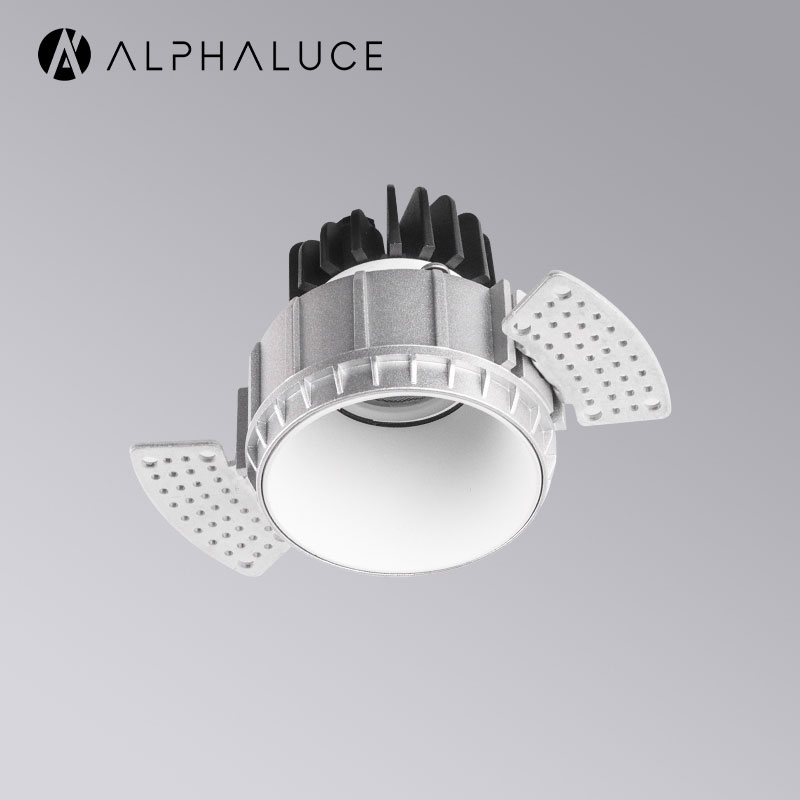
Trimless models like the ALDL1609 minimize visual clutter and create a continuous ceiling plane.
Step-by-Step Guide to Selecting Recessed Downlights
To turn a project requirement into a robust purchase order, use this seven-step workflow.
Step 1: Verify Market Certifications
Identify the destination market and list the mandatory compliance marks. For the EU, check CE-EMC and CE-LVD. For North America, verify UL 1598 or CSA C22.2 No. 250.0. Ask the manufacturer to provide the certificate number and confirm that the exact model you plan to order is included in the certificate's scope.
Step 2: Determine the IP Rating for the Installation Zone
For interior dry areas such as living rooms and bedrooms, IP20 is typically sufficient. For bathrooms, consult the relevant electrical regulations. In the UK, BS 7671 requires IP65 in Zone 1 and at least IP44 in Zone 2. For outdoor covered areas or kitchens, IP54 or IP65 may be necessary. The ALDL1232 offers an IP65 rating in a trimless form factor for demanding wet areas.
Step 3: Set the Minimum CRI
Color rendering affects how accurately materials and skin tones appear. For residential and commercial spaces, CRI ≥90 is the standard baseline. For boutique hospitality projects and gallery-style interiors, specify CRI ≥95 or higher. The ALDL1851 achieves CRI ≥97 for premium applications. If color consistency across a large installation matters, also check the SDCM rating; a lower MacAdam step (3-step vs 4-step) indicates tighter color consistency.
Step 4: Define Beam Angle and Optical Control
Narrow beam angles (15°–24°) create pools of accent light for art or display. Medium angles (36°) suit general downlighting in corridors and workspaces. Wide angles (55°–70°) are ideal for ambient wash. For accent lighting with adjustable aim, the ALDL1587 allows tilt and rotation to direct light precisely.
Step 5: Select Dimming and Control Architecture
Projects with scene control require dimmable drivers and compatibility with protocols such as DALI, 1–10V, Triac, or Bluetooth. The ALDL1405 supports optional DALI or 1–10V dimming and is a common choice for hospitality and residential projects where scene-setting is required.
Step 6: Evaluate Material and Finish
Aluminum alloy housings with powder-coated or anodized finishes provide durability and consistent appearance. Black finish downlights reduce glare and help the fixture recede into a dark ceiling. Trimless options eliminate the visible flange, while narrow-trim designs provide a minimal reveal without requiring plaster-in installation.
Step 7: Review Warranty and Manufacturer Support
Confirm the warranty period and the manufacturer's after-sales policy. ALPHALUCE backs its products with a 5-year warranty and supports OEM/ODM customization of color, CCT, beam angle, power, surface finish, and logo. The company offers a monthly capacity of 42,000 units, with a standard lead time of 20–30 days and a MOQ of 100 units.
Real-World Applications and Installation Cases
Recessed downlights are applied across a wide range of project types. The following examples illustrate common scenarios based on documented ALPHALUCE project data.
Hospitality and Luxury Hotels
Hospitality projects often demand a warm color temperature, high color rendering, and glare-free operation. In hotels across South Korea, Thailand, Sri Lanka, and Fiji, ALPHALUCE recessed downlights were used in quantities of 200–500 units per project to achieve consistent 3000K ambiance in lobbies, corridors, and guestrooms with ultra-low-glare optics. These installations required seamless integration with custom dimming systems to enable dynamic scene transitions between public spaces.
Residential and High-End Apartments
For residential projects, the priority is visual comfort and integration. A 760 sqm penthouse project and high-end villa communities in China used frameless, trimless downlights to maintain an unobtrusive ceiling plane. In the luxury Thai villa segment, ALPHALUCE adjustable recessed downlights supported minimalist decorative lighting that balanced Italian design language with tropical architecture.
Commercial and Showroom Spaces
Showrooms and exhibition spaces require flexible highlighting of materials and finishes. A 700 sqm immersive showroom in Guangzhou used trimless, anti-glare luminaires to create an "invisible fixture" aesthetic while preserving the visual texture of premium surfaces. In office environments, human-centric lighting designs with high CRI and low glare were implemented to support employee comfort and task performance.
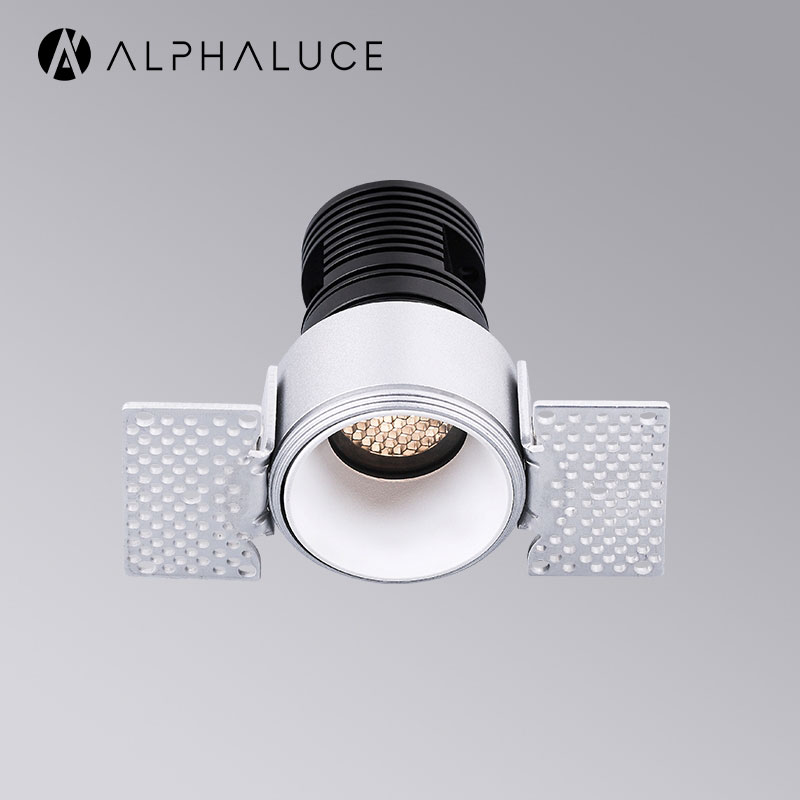
IP65-rated trimless downlights such as the ALDL1232 are engineered for bathrooms and humid environments.
Comparison of Popular ALPHALUCE Recessed Downlights
| Selection Criteria | ALDL1851 | ALDL1609 | ALDL1232 | ALDL1587 | ALDL1405 |
|---|---|---|---|---|---|
| Best For | Premium residential, hospitality accents | Architectural seamless ceilings | Bathrooms, wet areas, outdoor covered zones | Adjustable accent display | General ambient lighting with dimming |
| Maximum CRI | ≥97 | ≥92 | ≥92 | ≥92 | ≥92 |
| Highest IP Rating | IP20 | IP20 | IP65 | IP20 | IP44 |
| Beam Options | 15° / 24° / 36° / 55° | 15° / 24° / 36° / 55° | 15° / 24° / 36° / 55° | 15° / 24° / 36° / 55° | 70° |
| Trim Style | Trim | Trimless | Trimless | Trim | Trim |
| Adjustable Aim | No | No | No | Yes | No |
| Dimming Options | — | — | — | — | DALI / 1–10V |
| Cutout Size | Ø55mm | Ø76–80mm | Ø60mm | Ø68–70mm | Ø150mm |
Frequently Asked Questions
1. What certifications should I verify for a CE-compliant trimless recessed downlight?
For the European Union, the essential compliance certificates are CE-EMC (covering electromagnetic compatibility) and CE-LVD (covering electrical safety). Look for standards such as EN IEC 55015 and EN IEC 61547 for EMC, and EN 60598-1 with EN 60598-2-2 for safety. In addition, RoHS certification confirms that the fixture meets hazardous substance limits. ALPHALUCE's recessed downlight range, including trimless models, is certified to these requirements.
2. Are IP65-rated trimless downlights available for bathrooms and wet areas?
Yes. The ALDL1232 is a fixed, trimless recessed downlight with IP65 protection, rated at 7W with 508 lumens and CRI ≥92. It is suitable for bathroom Zone 1 installations and other humid interior environments where moisture resistance is required.
3. What is the advantage of a trimless recessed downlight over a trimmed fixture?
A trimless downlight sits flush with the finished ceiling surface, eliminating the visible frame or bezel. This delivers a clean, minimalist ceiling line that aligns with contemporary architectural design. The ALDL1609 is an example of a trimless model that supports cutout diameters of 76–80mm while maintaining a 7W / 630lm output and CRI ≥92.
4. Does ALPHALUCE support custom specifications or OEM projects?
ALPHALUCE offers OEM/ODM production with customization options for color, CCT, beam angle, power, surface finish, and logo. The monthly production capacity is 42,000 units, with a standard lead time of 20–30 days and a minimum order quantity of 100 units. Every unit undergoes 100% inspection and an aging test before shipping.
5. What warranty is provided on ALPHALUCE recessed downlights?
ALPHALUCE provides a 5-year warranty on its lighting products. This warranty covers manufacturing defects and is backed by the company's in-house quality control process, which includes full inspection and burn-in testing of every unit prior to delivery.
Conclusion
Recessed downlights are a specification-intensive product category. Balancing certification requirements, IP ratings, color rendering, beam control, and dimming compatibility is essential for project success. ALPHALUCE's portfolio demonstrates how a vertically integrated manufacturer can support these constraints through validated certifications, documented performance parameters, and flexible OEM/ODM production.
For architects and buyers evaluating CE-certified, high-CRI, or IP65-rated recessed downlights, the key is to align every technical requirement with documented evidence. Start by confirming certifications, then map the performance data to the application. This systematic approach reduces risk and ensures the final installation meets both the design brief and the regulatory framework.
Download the ALPHALUCE catalog to review the complete recessed downlight range, including trimless, dimmable, and IP65 models.
Get the catalogHave Questions or Need More Details?
Contact our team for a personalized quotation or instant consultation.
Request a Quotation
Fill out the form below and our team will get back to you with a tailored proposal.
WhatsApp Direct Chat
Prefer to chat in real-time? Message us on WhatsApp for instant assistance & quick answers.
- Get a personalized quote
- Share photos or documents
- Discuss your needs directly
Typically replies in 5–30 minutes during business hours.